Co-investigator Oli Mould reports on OHEM’s witness seminar on art, music and activism
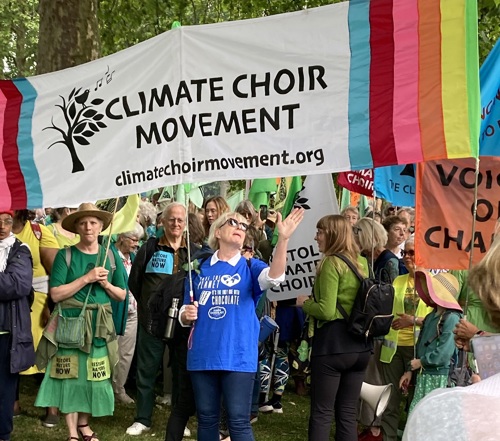
Climate Choir on the way to the Restore Nature Now March, London 22nd June 2024.
Photograph: Barbara Brayshay
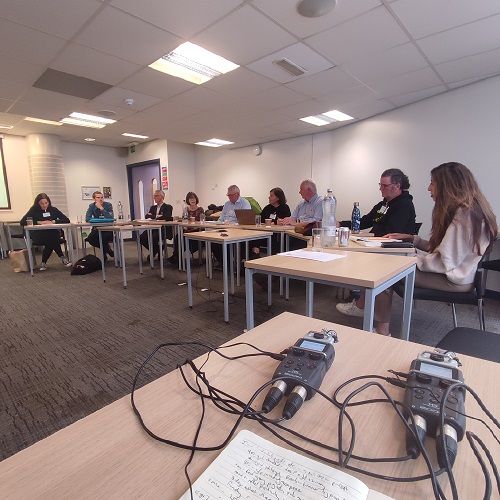
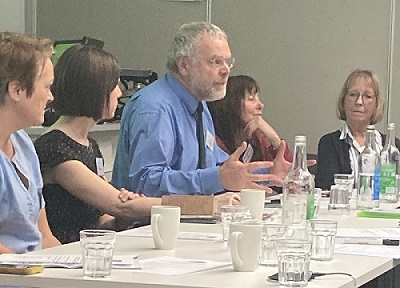
Earlier this year the project convened a witness seminar to discuss the role of "artivism" — the intersection of creative arts and activism — within environmentalism in the UK.
Participants included musicians, artists, activists, and curators associated with Extinction Rebellion (XR), Music Declares Emergency, Greenpeace, and other cultural initiatives with activist tendencies. The discussion offered hugely enlightening and important insights into the evolving nature of environmental activism in the UK, suggesting that creativity is no longer peripheral to activism but is increasingly central to its methods, structures, and ethos.
This blog post explores the key themes emerging from that conversation and considers what they reveal about the contemporary environmental movement.
Participants repeatedly challenged the idea that art is merely a tool to communicate pre-existing activist messages. Instead, they positioned artistic practice as a mode of activism itself – a "doing" rather than a representation. Chris Garrard, for instance, argued for understanding collective artmaking as an integral part of activist organising, akin to the devising of theatre or musical performance.
The artwork becomes a social event rather than a static object. In the environmental movement, such practices (from samba drumming at protests to participatory choir performances), create ephemeral spaces of collective resistance and emotional engagement, challenging the reduction of activism to slogans or policy demands.
A striking theme was the emphasis on accessibility. Movements such as XR Rhythms and the Climate Choir Movement create low-threshold entry points, requiring no specialised musical, political, or scientific knowledge. As Victor Smith of XR Drummers noted, one simply needs the willingness to engage, “vaguely left-wing politics and a desire to bang a drum.”
Climate Choir: ‘People have the Power’ (video). Restore Nature Now March, London 22nd June 2024. Copyright: Bob Chase, London Climate Choir
This democratization of participation aligns with theories of prefigurative politics (Yates, 2015), where the process of activism models the inclusive, horizontal societies activists seek to create. It also reflects a reaction against activist spaces that are perceived as insular or dominated by technical expertise, a criticism long noted within the social movements literature.
Participants Maeve Bayton and Bob Wilson provided valuable historical context, situating contemporary artivism within a longer tradition of DIY political culture. The feminist punk scene of the 1970s–80s, Greenham Common Women’s Peace Camp, and anti-nuclear concerts were cited as precedents where music and art were inseparable from activism.
This historical grounding suggests that the current wave of environmental artivism is less a rupture than a renewal. It maintains the ethos of autonomy from commercial and institutional structures, echoing the critique of corporate sponsorship and "culture-washing" seen in campaigns like BP or Not BP.
A recurring tension was the involvement of professional musicians and public figures. While artists such as Billie Eilish and Coldplay have engaged with climate themes, participants highlighted how celebrity involvement is increasingly shaped by the risks of social media backlash, industry pressures, and "issue fatigue." Fay Milton of Music Declares Emergency emphasized that while many musicians care deeply, the hyper-mediated nature of contemporary fame makes sustained activism challenging.
This observation aligns with recent analyses of "woke capitalism" and the pressures on cultural figures to navigate activism within neoliberal media ecosystems. It also underlines a broader point: while professionals contribute valuable skills, much of the energy and innovation in environmental artivism emerges from grassroots, amateur-led initiatives.
Music and sound were repeatedly described as central not merely to morale but to the dynamics of protest itself. Whether through samba rhythms or spontaneous choral singing, sound was seen to collectivise emotion, disrupt public spaces, and create affective solidarities. Sound, in this context, is not ornamental; it is a tactic of presence and disruption, a claim to space and to possibility.
Finally, participants acknowledged the persistent challenges of ensuring that environmental artivism is inclusive and intersectional. Issues of racial and class homogeneity within groups such as XR were raised, and there was recognition that environmental activism must be entwined with struggles against colonialism, racism, and global inequalities.
Such reflections align with the critique that mainstream environmentalism often reproduces hegemony and exclusionary practices unless it actively centres environmental justice. The focus group’s willingness to confront these tensions suggests a maturation of environmental artivism: an awareness that aesthetic innovation must be matched by political reflexivity.
The discussion at this event revealed a movement that is increasingly experimental, collective, and self-critical. Art is not merely a means of communication or decoration within environmental activism, it is its method, its spirit, and increasingly its infrastructure.
As the environmental crisis deepens, it seems that the future of activism will be as much about creating shared spaces of hope, resistance, and imagination as about traditional campaigning. In that sense, the drums, choirs, performances, and public art interventions of today are not just background noise, they are the pulse of a movement fighting not just for survival, but for transformation.
Our thanks to all the participants for giving us their time and insights.
Witness seminar: Artivism - transcript of proceedings