




Course options
Key information
Duration: 3 years full time
UCAS code: G100
Institution code: R72
Campus: Egham
The course
Mathematics (BSc)
Understand and master the universal structures that govern the world. Study our BSc in Mathematics and get equipped with practical skills and experience to set you apart.
Maths can be found at the heart of everything, from financial markets and transportation to quantum computers, the security of mobile phones and medical science. Learn how to solve real-world problems while putting yourself at the cutting edge of technology.
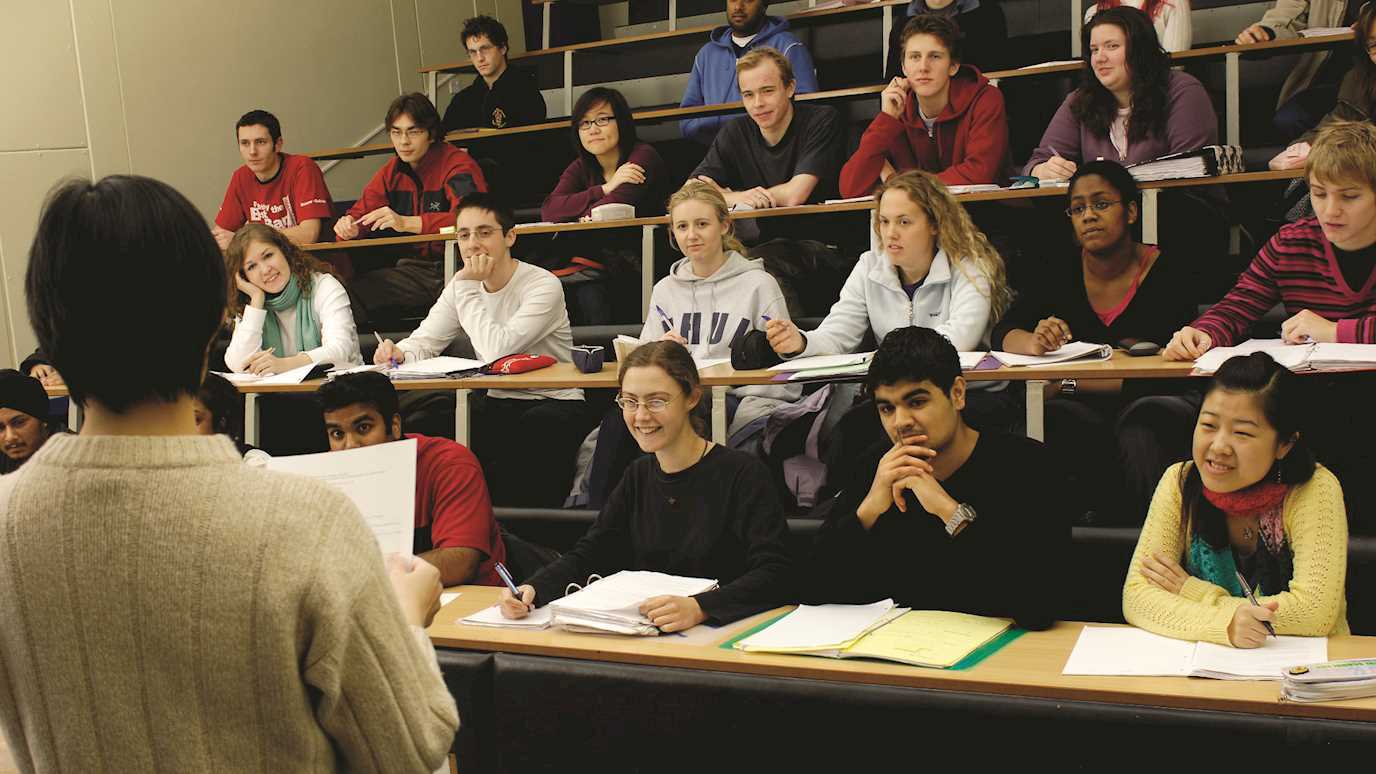
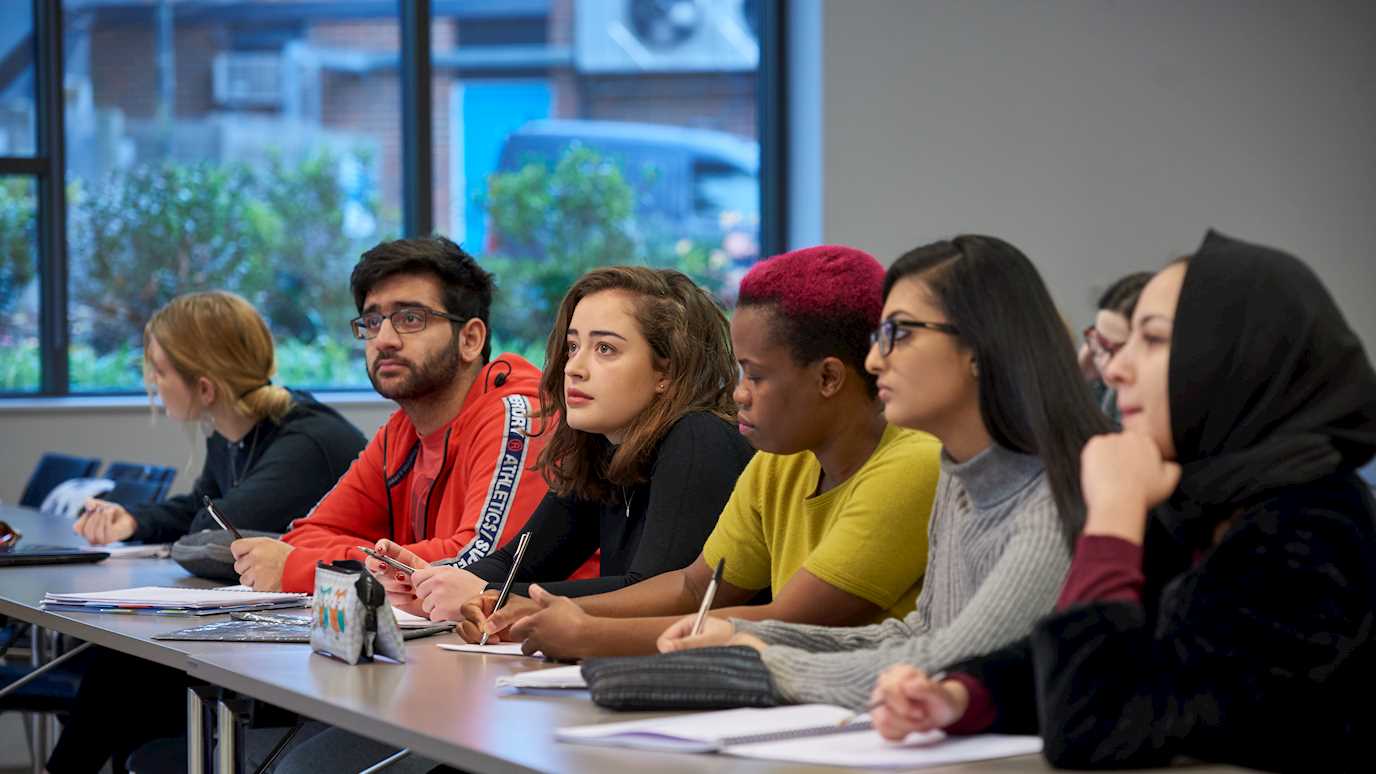
We’re a friendly and enthusiastic team, who’ll treat you as an individual. Enjoy small group tutorials, problem-solving sessions, and practical workshops. Discuss your studies and career plans with your personal tutor on hand to provide you with help and guidance.
Bringing maths to life
- Be inspired by our researchers, known for their work in pure mathematics, probability, and quantum theory
- Gain employability skills with training embedded in all three years, to help your CV stand out
- Get a sense for what maths research feels like through an optional third-year supervised project
Putting maths to work
You’ll develop numeracy, analytical, data handling, logical thinking, coding and creative problem-solving abilities. Skills that put you in demand with employers.
The financial sector is a natural choice once you graduate. But you can do just about anything with your degree in maths. In a changing world, the skills you’ll bring will always be needed, valued and rewarded.
We sometimes make changes to our courses to improve your experience. If this happens, we’ll let you know as soon as possible.
Course structure
Core Modules
Year 1
-
On completion of the module, students should be able to understand a range of topics in elementary geometry.
-
In this module, you will develop an understanding of how the techniques for solving differential equations can be applied to describe the real world. You will look at situations from balls flying through the air to planets orbiting the stars, including why the moon continues to orbit the Earth and not the Sun. You will consider the chaotic motion of a pendulum, and examine Einstein's theory of special relativity to describe the propagation of matter and light at high speeds.
-
In this module you will develop an understanding of the notion of probability and the basic theory and methods of statistics. You will look at random variables and their distributions, calculate probabilities of events that arise from standard distributions, estimate means and variances, and carry out t tests for means and differences of means. You will also consider the notions of types of error, power and significance levels, gaining experience in sorting a variety of data sets in a scientific way.
-
This module aims to develop the students’ confidence and skill in dealing with mathematical expressions, to extend their understanding of calculus, and to introduce some topics which they may not have met at A-level. It also aims to ease the transition to university work and to encourage the student to develop good study skills.
-
In this module you will develop an understanding of the calculus functions of more than one variable and how it may be used in areas such as geometry and optimisation. You learn how to manipulate partial derivatives, construct and manipulate line integrals, represent curves and surfaces in higher dimensions, calculate areas under a curve and volumes between surfaces, and evaluate double integrals, including the use of change of order of integration and change of coordinates.
-
In this module you will develop an understanding of the fundamental algebraic structures, including familiar integers and polynomial rings. You will learn how to apply Euclid's algorithm to find the greatest common divisor of two integers, and use mathematical induction to prove simple results. You will examine the use of arithmetic operations on complex numbers, extract roots of complex numbers, prove De Morgan's laws, and determine whether a given mapping is bijective.
-
In this module you will develop an understanding of basic linear algebra, in particular the use of matrices and vectors. You will look at the basic theoretical and computational techniques of matrix theory, examining the power of vector methods and how they may be used to describe three-dimensional space. You will consider the notions of field, vector space and subspace, and learn how to calculate the determinant of an n x n matrix.
-
Real analysis studies the behaviour of the real numbers and real-valued functions. It provides the foundations of calculus, and is essential to both pure and applied mathematics. This module provides a user-friendly introduction to key ideas of real analysis, illustrated with copious examples. It examines topics such as the properties and axioms of the real numbers, and convergence of infinite sequences and infinite series.
Year 2
-
In this module you will develop an understanding of the basic principles of the mathematical theory of probability. You will use the fundamental laws of probability to solve a range of problems, and prove simple theorems involving discrete and continuous random variables. You will learn how to formulate and explain fundamental limit theorems, such as the weak law of large numbers and the central limit theorem.
-
This course introduces you to the basics of Python programming for building solutions to mathematics-based tasks. This will encourage a deeper understanding of the mathematics that you will learn across your degree, developing general mathematical skills and group working. Additionally, the module will provide guidance through the process of applying for a summer internship or job, as well as reviewing the range of career options available to Mathematicians upon graduation.
-
In this module you will develop an understanding of vectors and matrices within the context of vector spaces, with a focus on deriving and using various decompositions of matrices, including eigenvalue decompositions and the so-called normal forms. You will learn how these abstract notions can be used to solve problems encountered in other fields of science and mathematics, such as optimisation theory.
Year 3
-
The aim of this module is to enable you to plan and carry out longer assignments, which require significant preparation and/or advanced data analysis. This module will lay the groundwork for the comprehensive project work undertaken in your final year project whilst introducing you to some of the research activities within the Department. You will establish skills including report writing and oral presentations in the context of employment.
Optional Modules
Below is a taster of some of the exciting optional modules that students on the course could choose from during this academic year. Please be aware these do change over time, and optional modules may be withdrawn or new ones added.
Year 1
-
All modules are core
Year 2
-
In this module the vector calculus methods are applied to a variety of problems in the physical sciences, with a focus on electromagnetism and optics. On completion of the module, the student should be able to calculate relevant physical quantities such as field strengths, forces, and energy distributions in static as well as dynamical electromagnetic systems and be able to treat mathematically the interactions between moving electrical charges, magnets and optical fields.
-
In this module you will develop an understanding of statistical modelling, becoming familiar with the theory and the application of linear models. You will learn how to use the classic simple linear regression model and its generalisations for modelling dependence between variables. You will examine how to apply non-parametric methods, such as the Wilxocon and Kolmogorov-Smirnov goodness-of-fit tests, and learn to use the R open source software package.
-
In this module you will develop an understanding of the basic principles of the mathematical theory of probability. You will use the fundamental laws of probability to solve a range of problems, and prove simple theorems involving discrete and continuous random variables. You will learn how to formulate and explain fundamental limit theorems, such as the weak law of large numbers and the central limit theorem.
-
In this module you will develop an understanding of the concepts arising when the boundary conditions of a differential equation involves two points. You will look at eigenvalues and eigenfunctions in trigonometric differential equations, and determine the Fourier series for a periodic function. You will learn how to manipulate the Dirac delta-function and apply the Fourier transform. You will also examine how to solve differential equations where the coefficients are variable.
-
In this module you will develop an understanding of ring theory and how this area of algebra can be used to address the problem of factorising integers into primes. You will look at how these ideas can be extended to develop notions of 'prime factorisation' for other mathematical objects, such as polynomials. You will investigate the structure of explicit rings and learn how to recognise and construct ring homomorphisms and quotients. You will examine the Gaussian integers as an example of a Euclidean ring, Kronecker's theorem on field extensions, and the Chinese Remainder Theorem.
Year 3
-
You will carry out a detailed investigation on a topic of your choosing, guided by an academic supervisor. You will prepare a written report around 7,000 words in length, and give a ten-minute presentation outlining your findings.
-
In this module you will develop an understanding of a range of methods for teaching children up to A-level standard. You will act as a role model for pupils, devising appropriate ways to convey the principles and concepts of mathematics. You will spend one session a week in a local school, taking responsibility for preparing lesson plans, putting together relevant learning aids, and delivering some of the classes. You will work with a specific teacher, who will act as a trainer and mentor, gaining valuable transferable skills.
-
In this module you will develop an understanding of how prime numbers are the building blocks of the integers 0, ±1, ±2, … You will look at how simple equations using integers can be solved, and examine whether a number like 2017 should be written as a sum of two integer squares. You will also see how Number Theory can be used in other areas such as Cryptography, Computer Science and Field Theory.
-
In this module you will develop an understanding of quantum theory, and the development of the field to explain the behaviour of particles at the atomic level. You will look at the mathematical foundations of the theory, including the Schrodinger equation. You will examine how the theory is applied to one and three dimensional systems, including the hydrogen atom, and see how a probabilistic theory is required to interpret what is measured.
-
In this module you will develop an understanding of non-linear dynamical systems. You will investigate whether the behaviour of a non-linear system can be predicted from the corresponding linear system and see how dynamical systems can be used to analyse mechanisms such as the spread of disease, the stability of the universe, and the evolution of economic systems. You will gain an insight into the 'secrets' of the non-linear world and the appearance of chaos.
-
In this module you will develop an understanding of some of the techniques and concepts of combinatorics, including methods of counting, generating functions, probabilistic methods, permutations, and Ramsey theory. You will see how algebra and probability can be used to count abstract mathematical objects, and how to calculate sets by inclusion and exclusion. You will examine the applications of number theory and consider the use of simple probabilistic tools for solving combinatorial problems.
-
In this module you will develop an understanding of the algebraic structures known as groups. You will look at how groups represent symmetries in the world around us, examining examples that arise from the theory of matrices and permutations. You will see how groups are ubiquitous and used in many different fields of human study, including mathematics, physics, the study of crystals and atoms, public key cryptography, and music theory. You also will also consider how various counting problems concerning discrete patterns can be solved by means of group actions.
-
In this module you will develop an understanding of geometric objects and their properties. You will look at objects that are preserved under continuous deformation, such as through stretching or twisting, and will examine knots and surfaces. You will see how colouring a knot can be used to determine whether or not it can be transformed into the unknot without any threading. You will also consider why topologists do not distinguish between a cup and a donut.
-
In this module you will develop an understanding of the algebraic structures known as groups. You will look at how groups represent symmetries in the world around us, examining examples that arise from the theory of matrices and permutations. Groups are ubiquitous and used in many different fields of human study, including mathematics, physics, the study of crystals and atoms, public key cryptography, and music theory.
-
In this module you will develop an understanding of the probabilistic methods used to model systems with uncertain behaviour. You will look at the structure and concepts of discrete and continuous time Markov chains with countable stable space, and consider the methods of conditional expectation. You will learn how to generate functions, and construct a probability model for a variety of problems.
-
Optimisation problems usually seek to maximise or minimise some function subject to a number of constraints; for example, how products should be shipped from factories to shops so as to minimise cost, or finding the shortest route a delivery driver should take. Linear programming is concerned with solving optimisation problems whose requirements are represented by linear relationships. This module introduces different types of optimisation problems and the appropriate approaches for solving each type of problem.
-
In this module you will develop an understanding of the main principles and methods of statistics, in particular the theory of parametric estimation and hypotheses testing. You will learn how to formulate statistical problems in mathematical terms, looking at concepts such as Bayes estimators, the Neyman-Pearson framework, likelihood ratio tests, and decision theory.
-
This module shows how mathematics is used by those who work in securities markets. The topics in the module are chosen to demonstrate important applications, and may include the basic asset pricing models, the general behaviour of markets, the theory of derivative securities and elements of portfolio theory.
-
This module continues the study of financial mathematics begun in Financial Mathematics I. In this module, students will develop a further understanding of the role of mathematics in securities markets. The topics in the module may include models of interest rates, elements of portfolio theory and models for financial returns.
-
This module will analyse ways in which mathematics can be applied to situations that involve making strategic decisions, and will apply game theory to a wide variety of situations including to examples from business and economics.
-
In this module you will develop an understanding of how the behaviour of quantum systems can be harnessed to perform information processing tasks that are otherwise difficult, or impossible, to carry out. You will look at basic phenomena such as quantum entanglement and the no-cloning principle, seeing how these can be used to perform, for example, quantum key distribution. You will also examine a number of basic quantum computing algorithms, observing how they outperform their classical counterparts when run on a quantum computer.
Teaching & assessment
The course has a flexible, modular structure and you will take a total of 12 course units at a rate of four, 30-credit modules per year. In addition to our compulsory core modules, you will be free to choose between a number of optional courses. Some contribute 15 credits to your overall award while others contribute the full 30.
We use a variety of teaching methods and there is a strong focus on small group teaching in the department. You will attend 12 to 15 hours of formal teaching in a typical week, including lectures, tutorials, problem-solving workshops and practical sessions in statistics and computational mathematics. You will also be expected to work on worksheets, revision and project work outside of these times. In year 2, teaching will mainly be delivered through lectures and workshops and in year 3, mostly through relatively small group lectures.
Our courses are mostly examined by written exams taken in the summer term, but some of our statistics and computational courses also have project components and between 10% and 30% of your final mark for each core module in year 1 will come from coursework. Some of the first year modules also include tests that contribute 10% of the final mark. In the first term of year 2 you will work in small groups to prepare a report and an oral presentation on a mathematical topic of your choice, which will contribute to one of your core module grades. CV writing skills are also embedded into that course. In year 3 there are two optional courses which are examined solely by a project and presentation.
Entry requirements
A Levels: ABB-ABC
Required subjects:
- A-level Mathematics at grade A
- We require English and Mathematics GCSE at grade 4/C
75% with at least 9 in any subjects specified in GCE A-level entry requirements shown above.
If you have completed Secondary or High School in this country then you will need to take our one year International Foundation Year , or the equivalent from another institution, before beginning your undergraduate studies.
Achieve a grade of 86 overall in your ATAR with a grade A in a Major Unit of a T type course in any A-level subject specified above.
Achieve a grade of 2 overall in your Reifezeugnis/Maturazeugnis with a grade 1.5 in any A-level subject specified above.
If you have completed Secondary or High School in this country then you will need to take our one year International Foundation Year , or the equivalent from another institution, before beginning your undergraduate studies.
If you have completed Secondary or High School in this country then you will need to take our one year International Foundation Year , or the equivalent from another institution, before beginning your undergraduate studies.
Achieve a grade of 7/10 or 15/20 or 60% overall in your Certificate D Enseignement Secondaire Superieur (CESS) or Diploma van Hoger Secundair Onderwijs with a grade 18 in any A-level subject specified above.
Achieve a grade of 3/5 overall in your Secondary School Leaving Diploma with a grade 4 in any A-level subject specified above.
Achieve a grade of 5.3 overall in your Diploma za Sredno Obrazovanie with a grade 5 in any A-level subject specified above.
Achieve a grade of 80% overall in grade 12 subjects in your Various Year 12 High School Graduation Diplomas with a grade 85% in any A-level subject specified above.
Achieve a grade of 75% overall in the National College Entrance Examination (NCEE) (Gaokao) with 70% in any A-level subject specified above. For students who do not meet this requirement, our partner Foundation course provider may be able to help. For more information please view - www.rhulisc.com
Achieve a grade of 4 overall in your Svjedodzba o Maturi with a grade 5 in any A-level subject specified above.
Achieve a grade of 18 overall in your Apolytirion with a grade A or 19 in any A-level subject specified above.
Achieve a grade of 2.3 overall in your Maturitni Zkouska / Maturita with a grade 1 in any A-level subject specified above.
Achieve a grade of 7 overall in your Bevis for Studentereksamen or Hojere Forberedelseseksamen or Hojere Handelseksamen or Hojere Teknisk Eksamen with a grade 12 in any A-level subject specified above.
Achieve ABC in the Certificate of Nile Secondary Education (CNISE) Level 3 with a grade A in any A-level subject specified above.
Achieve a grade of 3.7 overall in your Gumnaasium Ioputunnistus together with 68% Riigieksammid with a grade 5 in any A-level subject specified above.
Achieve a grade of MMMM overall in your Ylioppilastutkinto / studentexamen with a grade E in any A-level subject specified above.
Achieve a grade of 12/20 overall in your Baccalaureat / International Option Baccalaureate with a grade 14 in any A-level subject specified above.
Achieve a grade of 2 overall in your Zeugnis der Allgemeinen Hochschulreife / Abitur with a grade 14 in any A-level subject specified above.
If you have completed Secondary or High School in this country then you will need to take our one year International Foundation Year , or the equivalent from another institution, before beginning your undergraduate studies.
Achieve a grade of 18 overall in your Apolytirion of Lykeion with a grade A or 19.5 in any A-level subject specified above.
Achieve a grade of 5,4,4 overall in your Hong Kong Diploma of Secondary Education with a grade 5 in any A-level subject specified above.
Achieve a grade of 4.3 overall in your Erettsegi / Matura with a grade 5 in any A-level subject specified above.
Achieve a grade of 7.5/10 overall in your Studentsprof (from Gymnasium) with a grade 9 in any A-level subject specified above.
Achieve a grade of 75% overall in your Higher Secondary School Certificate with a grade of 85% in any A-level subject specified above.
If you have completed Secondary or High School in this country then you will need to take our one year International Foundation Year , or the equivalent from another institution, before beginning your undergraduate studies.
Achieve a grade of 16/20 or 80% overall in your National Entrance Examination (Konkur)/ Kardani with a grade 16 or 80% in any A-level subject specified above.
If you have completed Secondary or High School in this country then you will need to take our one year International Foundation Year , or the equivalent from another institution, before beginning your undergraduate studies.
Achieve a grade of 8/10 overall in your Bagrut (Matriculation) or Mechina with a grade 8 in any A-level subject specified above.
Achieve a grade of 80 overall in your Esame di Stato with a grade of 18/20, 14/15 or 9/10 in any A-level subject specified above.
If you have completed Secondary or High School in this country then you will need to take our one year International Foundation Year , or the equivalent from another institution, before beginning your undergraduate studies.
If you have completed Secondary or High School in this country then you will need to take our one year International Foundation Year , or the equivalent from another institution, before beginning your undergraduate studies.
If you have completed Secondary or High School in this country then you will need to take our one year International Foundation Year , or the equivalent from another institution, before beginning your undergraduate studies.
Achieve a grade of 3.5 overall in your Diplome per Kryerjen e Shkolles se Mesme te Larte with a grade 5 in any A-level subject specified above.
If you have completed Secondary or High School in this country then you will need to take our one year International Foundation Year , or the equivalent from another institution, before beginning your undergraduate studies.
Achieve a grade of 8.0 overall in your Atestats par visparejo videjo izglitibu with a grade 9.5 in any A-level subject specified above.
If you have completed Secondary or High School in this country then you will need to take our one year International Foundation Year , or the equivalent from another institution, before beginning your undergraduate studies.
Achieve a grade of 5/6 overall in your Matura with a grade 5 in any A-level subject specified above.
Achieve a grade of 8.0 overall in your Brandos Atestatas Secondary School Diploma / Maturity Certificate with a grade 9/90% in any A-level subject specified above and at least 80% in three state exams.
Achieve a grade of 39 overall in your Diplome de Fin d'Etudes Secondaires with a grade 48 in any A-level subject specified above.
Achieve a grade of ABC overall in your Sijil Tinggi Persekolahan Malaysia with a grade A in any A-level subject specified above.
Achieve a grade of ABC overall in your Advanced Matriculation with a grade A in any A-level subject specified above.
Achieve ABC in the Cambridge Overseas Higher School Certificate/General Certificate of Education Advanced Level with grade A in any A-level subject specified above.
Achieve ABC in the Cambridge Overseas Higher School Certificate (COHSC) with grade A in any A-level subject specified above.
Achieve a grade of 6 overall in your Voorbereidend Wetenschappelijk Onderwijs with a grade 7 in any A-level subject specified above.
Achieve a grade of Merit overall from three subjects in your NCEA level 3 with a grade of Excellence in any A-level subject specified above.
If you have completed Secondary or High School in this country then you will need to take our one year International Foundation Year , or the equivalent from another institution, before beginning your undergraduate studies.
Achieve a grade of 4.2 overall in your Matura or School Leaving Certificate with a grade 5 in any A-level subject specified above.
Achieve a grade of 70% overall from the final 2 years in your 4-year Devlet Lise Diplomasi.
Achieve a grade of 4 overall in your Vitnemal - Videregaende Opplaering with a grade 5 in any A-level subject specified above.
If you have completed Secondary or High School in this country then you will need to take our one year International Foundation Year , or the equivalent from another institution, before beginning your undergraduate studies.
If you have completed Secondary or High School in this country then you will need to take our one year International Foundation Year , or the equivalent from another institution, before beginning your undergraduate studies.
Achieve a grade of 70% overall including 70% in three extended level subjects in your Swiadectwo Dojrzalosci / Matura with a grade of 80% in any A-level subject specified above.
Achieve a grade of 17 overall including 17,17,17 in 3 year 11 or 12 exams in your Certificado de fim de Estudos Secundarios with a grade 18 in any A-level subject specified above.
If you have completed Secondary or High School in this country then you will need to take our one year International Foundation Year , or the equivalent from another institution, before beginning your undergraduate studies.
Achieve a grade of 7 overall in your Diploma de Bacalaureat with a grade 9 in any A-level subject specified above.
If you have completed Secondary or High School in this country then you will need to take our one year International Foundation Year , or the equivalent from another institution, before beginning your undergraduate studies.
If you have completed Secondary or High School in this country then you will need to take our one year International Foundation Year , or the equivalent from another institution, before beginning your undergraduate studies.
Achieve a pass with grade 4 overall in your Secondary School Leaving Diploma with a grade 4 in any A-level subject specified above.
Achieve a GPA grade of 3.0 overall in your Singapore Polytechnic Diploma with a grade 3.5 in any A-level subject specified above.
Achieve a grade of 2 overall in your Maturitná skúška / Maturita with a grade 1.5 in any A-level subject specified above.
Achieve a grade of 4 overall in your Matura / Secondary School-Leaving Diploma / Technical Matura with a grade 5 in any A-level subject specified above.
Achieve a grades of 776666 in at least 6 subjects at Higher Grade in your National Senior Certificate (with matriculation endorsement) with a grade 7 in any A-level subject specified above.
If you have completed Secondary or High School in this country then you will need to take our one year International Foundation Year , or the equivalent from another institution, before beginning your undergraduate studies.
Achieve a grade of 7.5 overall in your Curso de Orientación Universitaria / Título de Bachillerato with a grade 8 in any A-level subject specified above.
If you have completed Secondary or High School in this country then you will need to take our one year International Foundation Year , or the equivalent from another institution, before beginning your undergraduate studies.
Achieve a grade of ABC overall in the Advanced Certificate of Secondary Education (CSEE) with a grade A in any A-level subject specified above.
If you have completed Secondary or High School in this country then you will need to take our one year International Foundation Year , or the equivalent from another institution, before beginning your undergraduate studies.
Achieve a grade of 70% overall from the final 2 years in your 4-year Devlet Lise Diplomasi / 4-year Lise Bitirme Diplomasi / 4-year Anadolu Lisesi / 2-year Ön-Lisans Diplomasi with a grade of 80% in any A-level subject specified above.
Achieve ABC in the Ugandan Advanced Certificate of Education (UACE) with a grade A in any A-level subject specified above.
If you have completed Secondary or High School in this country then you will need to take our one year International Foundation Year , or the equivalent from another institution, before beginning your undergraduate studies.
If you have completed Secondary or High School in this country then you will need to take our one year International Foundation Year , or the equivalent from another institution, before beginning your undergraduate studies.
Achieve a grade of 4 in at least two relevant AP Examinations; or a composite score of 25 in the ACT Examinations (including the ACT writing test) with an AP grade 4 or College Class B in any A-level subject specified above; or SAT 1100 with an AP grade 4 or College Class B in any A-Level subject specified above.) with an AP grade 4 or College Class B in any A-level subject specified above; or SAT 1200 with an AP grade 4 or College Class B in any A-Level subject specified above.riting test) with
Achieve a grade of 17/C or VG overall in your Avgangsbetyg / Fullständigt Slutbetyg fran Gymnasieskolan with a grade A or MVG in any A-level subject specified above.
If you have completed Secondary or High School in this country then you will need to take our one year International Foundation Year , or the equivalent from another institution, before beginning your undergraduate studies.
Achieve a grade of 222 overall at the two unit level in your Caribbean Advanced Proficency Examination with a grade 1 in any A-level subject specified above.
English language requirements
All teaching at Royal Holloway (apart from some language courses) is in English. You will therefore need to have good enough written and spoken English to cope with your studies right from the start.
The scores we require
- IELTS: 6.5 overall. No subscore lower than 5.5.
- Pearson Test of English: 67 overall. No subscore lower than 59.
- Trinity College London Integrated Skills in English (ISE): ISE III.
- TOEFL iBT: 88 overall, with Reading 18 Listening 17 Speaking 20 Writing 17.
- Duolingo: 120 overall and no sub-score below 100.
BSc Mathematics and Management
- IELTS: 6.5 overall with 6 in Writing and minimum of 5.5 in each subscore
- Pearson Test of English: 67 with 61 in writing (no other subscore lower than 54)
- Trinity College London Integrated Skills in English (ISE): ISE IV.
- Cambridge English: Advanced (CAE) grade C.
- TOEFL iBT: 88 overall, with Reading 18 Listening 17 Speaking 20 Writing 19
- Duolingo: 120 overall, 115 in Literacy, 115 in Production and no sub-score below 100.
BSc Mathematics and Music
- IELTS: 6.5 overall with 6 in Writing and minimum of 5.5 in each subscore
- Pearson Test of English: 67 with 61 in writing (no other subscore lower than 54)
- Trinity College London Integrated Skills in English (ISE): ISE IV.
- Cambridge English: Advanced (CAE) grade C.
- TOEFL iBT: 88 overall, with Reading 18 Listening 17 Speaking 20 Writing 19
- Duolingo: 120 overall, 115 in Literacy, 115 in Production and no sub-score below 100.
Country-specific requirements
For more information about country-specific entry requirements for your country please visit here.
Undergraduate preparation programme
For international students who do not meet the direct entry requirements, for this undergraduate degree, the Royal Holloway International Study Centre offers an International Foundation Year programme designed to develop your academic and English language skills.
Upon successful completion, you can progress to this degree at Royal Holloway, University of London.
Your future career
With our internationally recognised Mathematics degree you will be in demand for your numerical and analytical skills, data handling powers, creative and logical thinking and problem solving abilities. We are part of the School of Engineering, Physical and Mathematical Sciences and we enjoy strong ties with both the information security sector and industry at large. Our recent graduates have gone on to enjoy successful careers in: business management, IT consultancy, computer analysis and programming, accountancy, the civil service, teaching, actuarial science, finance, risk analysis, research and engineering. They work for organisations such as: KPMG, Ernst & Young, the Ministry of Defence, Barclays Bank, Lloyds Banking Group, the Department of Health, Logica, McLaren and TowersWatson, and in research teams tackling problems as diverse as aircraft design, operational research and cryptography. Depending on your choice of courses, you could also be eligible for certain membership exemptions from the Institute of Actuaries and other professional bodies.
We offer a competitive work experience scheme at the end of year 2, with short-term placements available during the summer holidays. You will also attend a CV writing workshop as part of your core modules in year 2, and your personal adviser and the campus Careers team will be on hand to offer advice and guidance on your chosen career. The University of London Careers Advisory Service also offers tailored sessions for mathematics students, on finding summer internships or holiday jobs and securing employment after graduation.
- Our mathematicians are in great demand from employers for their valuable skills.
- Our strong ties with industry mean we understand the needs of employers.
- Take advantage of our summer work placement scheme and fine-tune your CV before you enter your final year.
- Benefit from a personal adviser who will guide you through your many options.
Fees, funding & scholarships
Home (UK) students tuition fee per year*: £9,535
EU and international students tuition fee per year**: £28,500
Other essential costs***: There are no single associated costs greater than £50 per item on this course.
How do I pay for it? Find out more about funding options, including loans, scholarships and bursaries. UK students who have already taken out a tuition fee loan for undergraduate study should check their eligibility for additional funding directly with the relevant awards body.
*The tuition fee for Home (UK) undergraduates is controlled by Government regulations. This figure is the fee for the academic year 2025/26 and is shown as a guide. The fee for the academic year 2026/27 has not yet been announced.
**This figure is the fee for EU and international students on this course in the academic year 2026/27.
Royal Holloway reserves the right to increase tuition fees annually for all students. For further information see fees and funding.
*** These estimated costs relate to studying this particular degree at Royal Holloway during the 2026/27 academic year. Costs, such as accommodation, food, books and other learning materials and printing, have not been included.