Key information
Duration: 3 years full time
UCAS code: W4W6
Institution code: R72
Campus: Egham
The course
Drama with Film (BA)
By combining Drama (75% of your course) with Film (25%) you'll have the opportunity to study Drama and Theatre as the major element of your degree alongside film.
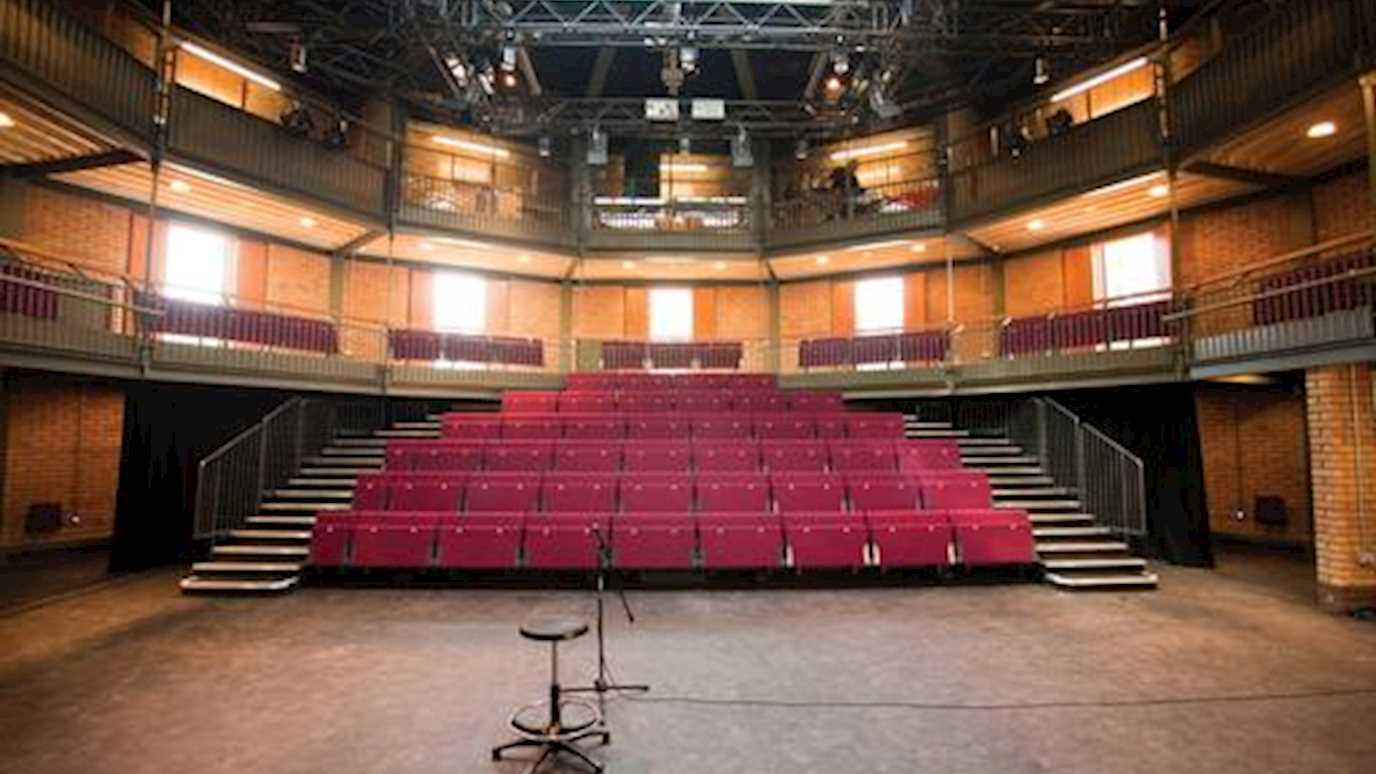
Choosing to study Drama at Royal Holloway will put you at the centre of one of the largest and most influential Drama and Theatre departments in the world. You'll create performances, analyse texts, and bring a range of critical ideas to bear on both. On this course the text and the body, thinking and doing, work together. There's no barrier between theory and practice: theory helps you understand and make the most of practice, while practice sheds light on theory. By moving between the two, you'll find your place as an informed theatre-maker, and by studying a variety of practices, by yourself and with others, you'll get knowledge of the industry as a whole, and learn how your interests could fit into the bigger picture.
We are top-rated for teaching and research, with a campus community recognised for its creativity. Our staff cover a huge range of theatre and performance studies, but we're particularly strong in contemporary British theatre, international and intercultural performance, theatre history, dance and physical theatre, and contemporary performance practices.
Film and television don't just shape culture: they create it. Our unique 360˚ approach to cinema allows you to understand film from every angle: from stars to directors, historical origins to contemporary economics, socio-political contexts, to aesthetic achievements and from the dynamics of screenplays to the global cultures that shape production, reception and film form itself. You'll come away from the course speaking confidently about concepts and ideas, with the ability to deftly critique them, too – ideal skills for the communication industries, creative arts and beyond. Taking this approach, you will study film and television from Hollywood and Europe, Bollywood, Asia and Latin America alongside a range of more experimental non-narrative film, television and digital media forms.
- Film studies makes up a quarter of your course.
- Study a range of practices, from physical theatre to contemporary British theatre.
- Be part of two complementary departments with a creative focus on interdisciplinarity.
- Reflect critically on performance and write film reviews.
- Contrast performance techniques for stage and screen.
We sometimes make changes to our courses to improve your experience. If this happens, we’ll let you know as soon as possible.
Course structure
Core Modules
Year 1
You will take the following modules in Drama:
-
-
-
-
Skills Lab offers a broad introduction to key working methods and research approaches in theatre and performance studies.
-
This module allows students to apply their critical understanding of screen narratives. They will do this through original creative screenwriting, detailed analysis, and theory. Students have to adapt a story into a 10m screenplay. This could be a short story, an album, or a video game.
-
This module allows students to apply their critical understanding of screen narratives. They will do this through original creative screenwriting, detailed analysis, and theory. Students have to adapt a story into a 10m screenplay. This could be a short story, an album, or a video game.
Year 2
-
In this module you will develop an understanding of the difference between stage acting and acting for camera. You will learn techniques for 'translating' your stage acting skills to mediated performance. You will collaborate through the year with directing students in the Department of Media Arts on an internal monologue film, a silent film, and a short scene, and these can later be used as part of an audition reel.
Year 3
Optional Modules
Below is a taster of some of the exciting optional modules that students on the course could choose from during this academic year. Please be aware these do change over time, and optional modules may be withdrawn or new ones added.
Year 1
-
All modules are core
Year 2
-
In this module you will develop an understanding of children's theatre and the current success of theatre for young audiences. You will look at the innovative performance styles of theatre companies such as Oily Cart and Theatre-rites, and consider how their work has been pushing the boundaries of contemporary theatre. You will examine the Unicorn theatre, the first purpose-built theatre for children in London; playwrights such as Charles Way, Philip Ridley, Neil Duffield, Mark Ravenhill and David Greig; and the work of theatremakers such as Mark Storor and Sue Buckmaster, who bring a blend of visual art, puppetry and live art to performances for children. You will critically analyse how performance installations can excite children’s imaginations, focusing on the visual, tactile and aural elements of theatre and performance.
-
In this module you will develop an understanding of the diverse art forms that investigate memory in dynamic conversation and the nature of art, history, and humanity. You will look at the disruption to the purpose, value, and nature of art in the aftermath of the cataclysmic events of the Holocaust, and move through the twentieth century to consider different cultures of memory, memorialisation, trauma, and witnessing. You will examine a wide range of cultural textual and performative genres, including first-hand testimony, plays, films, graphic novels, museums, and public monuments.
-
In this module you will develop an embodied understanding of culture. You will look at different cultural contexts for dance production, considering the context of where, when and how you dance. You will examine the cultural production and consumption of dance, exploring theories grounded in cultural studies and their implications on dance and dancing bodies, such as Marxism, post-modernism, feminism, post-structuralism, post-colonialism, gender and sexuality, and psychoanalysis. You will focus on popular dance, global popular culture, and dance on screen, and investigate the relationship between dance practices and the social, political and economic context in which they emerge. You will be encouraged to devise performances which creatively engage with cultural studies.
-
-
-
-
-
-
-
-
-
-
-
-
-
-
-
-
-
-
-
-
-
-
-
-
-
-
In this module you will develop an understanding of the core concepts of the digital age, looking at how today's computer networks, devices and infrastructure underpin nearly all forms of aesthetic, cultural social and political life. You will consider the concepts of technicity, affective turn, digital subjectivity and extended mind, creative expression and participation in the digital era, amateur production, free software, fun and politics, self-organisation, media archaeology and sonic architectures. You will examine the systematic challenges brought about by digital change and critically interpret and analyse digital phenomena.
-
In this module you will develop an understanding of how creativity is constrained and enabled by the industrial logics of the creative industries. You will focus on film, television and digital media, exploring issues such as economics and financing, pitching and commissioning, policy and regulation, copyright, formats and global trade, ratings and audience measurement, branding and marketing, digital production logics, and production cultures. You will also consider a number of important industry-oriented research skills, such as interviewing, market/demographic analysis, locating and interpreting legal documents, and archival research.
Year 3
-
-
-
-
-
-
-
-
This module will examine, through the employment of practical methodologies, the work of significant avant-garde sound/noise practitioners throughout the 20th century analogue and digital eras. It will examine the relationship between significant artworks and the technology of the era. For example, in the acoustic era of music capture, before the electrification of the signal in 1925 that allowed electro-magnetic microphones and soundboard input mixing, the capture of sound was facilitated through a static condensing horn. In order to create a mix balance, the musicians would physically move closer or further away from the horn. We call this kinetic mixing. One of the first exercises will be to recreate this process and then develop the concept digitally, within an installation paradigm, employing a multichannel sound source and a range of Bluetooth speakers, allowing the different sounds to be physically moved within a defined space – 21st Century kinetic mixing.
-
This module aims to give you as real an understanding and experience of working in the digital industries as is possible within the context of a university. This module will help you to gain an understanding of digital business modelling; from both a value building perspective, and also a relationship building perspective which is vital to your ongoing success.
-
-
-
-
-
In this module you will develop an understanding of how the destruction of European Jewry by the Nazis between 1933 and 1945 has been represented and responded to across a range of both fictional and non-fictional media. You will look at the specific theoretical debates surrounding how the Holocaust can or should (or should not) be represented in art and popular culture. You will consider the role of mass media in constructing both popular and elite relationships to historical experience, and in documenting history.
-
-
-
-
-
-
-
-
Teaching & assessment
Each year you will take three course units in Drama and one in Film.
The course has a modular structure, whereby students take 12 course units at the rate of four per year. Some course units are compulsory, while others are elective, thereby offering flexibility and some choice.
You'll be taught through a combination of lectures, seminar/workshops, and for Drama, presentation of your research and practical experimentation, with or without written texts. IT applications are used to explore many aspects of the subject, and we support your capability in this area through an Information Technology Skills course. Private study and preparation are essential parts of every course, and you will have access to many online resources and the University’s comprehensive e-learning facility, Moodle. Academic staff hold regular drop-in consultation sessions with students and, when you start with us, you will be assigned a Personal Tutor to support you academically and personally.
Assessment methods match the course content. For most course units, you will be assessed on pieces of work, usually an essay, or assignment such as a seminar presentation or a performance. You will sometimes be assessed as part of a group.
You will also take a study skills course during your first year, designed to equip you with and enhance the writing skills you will need to be successful in your degree. This course does not count towards your final degree award but you are required to pass it to progress to your second year.
The results of your first year qualify you to progress to the second year but do not contribute to your final degree award. The second and final year results do contribute to the final degree result, with the final year work counting double that of the second year.
All undergraduate degree courses at Royal Holloway are based on the course unit system. This system provides an effective and flexible approach to study, while ensuring that our degrees have a coherent and developmental structure.
Entry requirements
A Levels: ABB-BBC
Required subjects:
- We require English Language and Mathematics GCSE at grade 4 (C)
English language requirements
All teaching at Royal Holloway (apart from some language courses) is in English. You will therefore need to have good enough written and spoken English to cope with your studies right from the start.
The scores we require
- IELTS: 6.5 overall with 6 in Writing and minimum of 5.5 in each subscore
- Pearson Test of English: 67 with 61 in writing (no other subscore lower than 54)
- Trinity College London Integrated Skills in English (ISE): ISE IV.
- Cambridge English: Advanced (CAE) grade C.
- TOEFL iBT: 88 overall, with Reading 18 Listening 17 Speaking 20 Writing 19
- Duolingo: 120 overall, 115 in Literacy, 115 in Production and no sub-score below 100.
Country-specific requirements
For more information about country-specific entry requirements for your country please visit here.
Undergraduate preparation programme
For international students who do not meet the direct entry requirements, for this undergraduate degree, the Royal Holloway International Study Centre offers an International Foundation Year programme designed to develop your academic and English language skills.
Upon successful completion, you can progress to this degree at Royal Holloway, University of London.
Your future career
There are plenty of performance opportunities to get stuck into while you're here, and they'll stand you in good stead when you graduate. You'll be familiar and confident in performance situations (skills which are vital for leading meetings and make you viable for visible leadership roles). You'll come off as credible and composed. You'll also walk away with considerable experience of technical, intellectual, imaginative, and practical skills, valued by most employers. Aside from these performance skills, you'll also get skills in research and project management from the academic side of the course.
Our industry links mean you'll be able to pursue work experience with theatres and creative arts agencies. Recent graduates in the Department of Drama & Theatre have gone into careers in acting, writing, broadcasting (including at the BBC), literary agency, arts management, sound design, marketing/PR, teaching and community theatre work, as well as postgraduate study in different fields. Lots of our graduates also start their own performing arts companies.
Fees, funding & scholarships
Home (UK) students tuition fee per year*: £9,790
EU and international students tuition fee per year**: £27,900
Other essential costs***: Drama - There are no single associated costs with studying this course greater than £50 per item. It is a requirement to purchase a pair of safety boots in the first year, for which a range of cost options are available. Ticket costs for mandatory theatre trips are capped at £10. Film Studies - £80 to £500.
How do I pay for it? Find out more about funding options, including loans, scholarships and bursaries. UK students who have already taken out a tuition fee loan for undergraduate study should check their eligibility for additional funding directly with the relevant awards body.
*The tuition fee for Home (UK) undergraduates is controlled by Government regulations. This figure is the fee for the academic year 2026/27 and is shown as a guide. The fee for the academic year 2027/28 has not yet been confirmed.
**This figure is the fee for EU and international students starting a degree in the academic year 2026/27 and is shown as a guide. The fee for the academic year 2027/28 has not yet been confirmed.
Royal Holloway reserves the right to increase tuition fees annually for all students. For further information see fees and funding.
*** These estimated costs relate to studying this particular degree at Royal Holloway during the 2026/27 academic year and are included as a guide. Refers to specific individual items of £50 or more, and excludes accommodation, commuting, food, books/other learning materials and printing costs.