Key information
Duration: 5 years full time
UCAS code: HG29
Institution code: R72
Campus: Egham
The course
Computer Systems Engineering with a Year in Industry (MEng)
Computer systems engineering is a discipline that embodies the science and technology of design, construction, implementation, and maintenance of software and hardware components of modern computing systems, computer-controlled equipment, and networks of intelligent devices. It is solidly grounded in the theories and principles of computing, mathematics, science and engineering, and it applies these theories and principles to solve technical problems through the design of computing hardware, software, networks, and processes.
Creative technologies are at the core of the multimedia industries, but they are also changing the way we interact with computers and the real world. For work or entertainment, at home or in industrial environments, virtual/augmented reality is making its way into our everyday lives, requiring new tools (sensors, haptic devices) and approaches (artificial intelligence, storytelling).
This undergraduate degree will enable you to broaden your technological knowledge and understanding in Computer Sciences and Electronic Engineering and equip you with the practical skills that you will need to succeed in this fast moving and exciting area.
We offer a vibrant environment in which you can pursue your studies. You’ll study a combination of core courses in Computer Sciences and Electronic Engineering to introduce the theoretical knowledge and practical skills relevant to professional practice, with a range of specialist options from computer and network security systems, renewable energy systems, and smart transportation, to voice and music technologies, human factors and healthcare engineering.
The course will engage you imaginatively in the process of learning through creative hands-on group and individual project based activities, enabling you to develop your independent critical thinking and judgement. As well as the fundamentals of computer technologies and electrical/electronic engineering techniques, you’ll develop an appreciation of how electronics and computer systems engineering is the heart of many systems used on a daily basis, including mobile communications systems, computer system, transport systems, energy systems, software engineering, medical applications, domestic appliances, TV, radio, music studios and gaming devices.
- A degree course structured to develop ingenuity, creativity, invention and product development skills
- Enjoy varied, practical project-led learning.
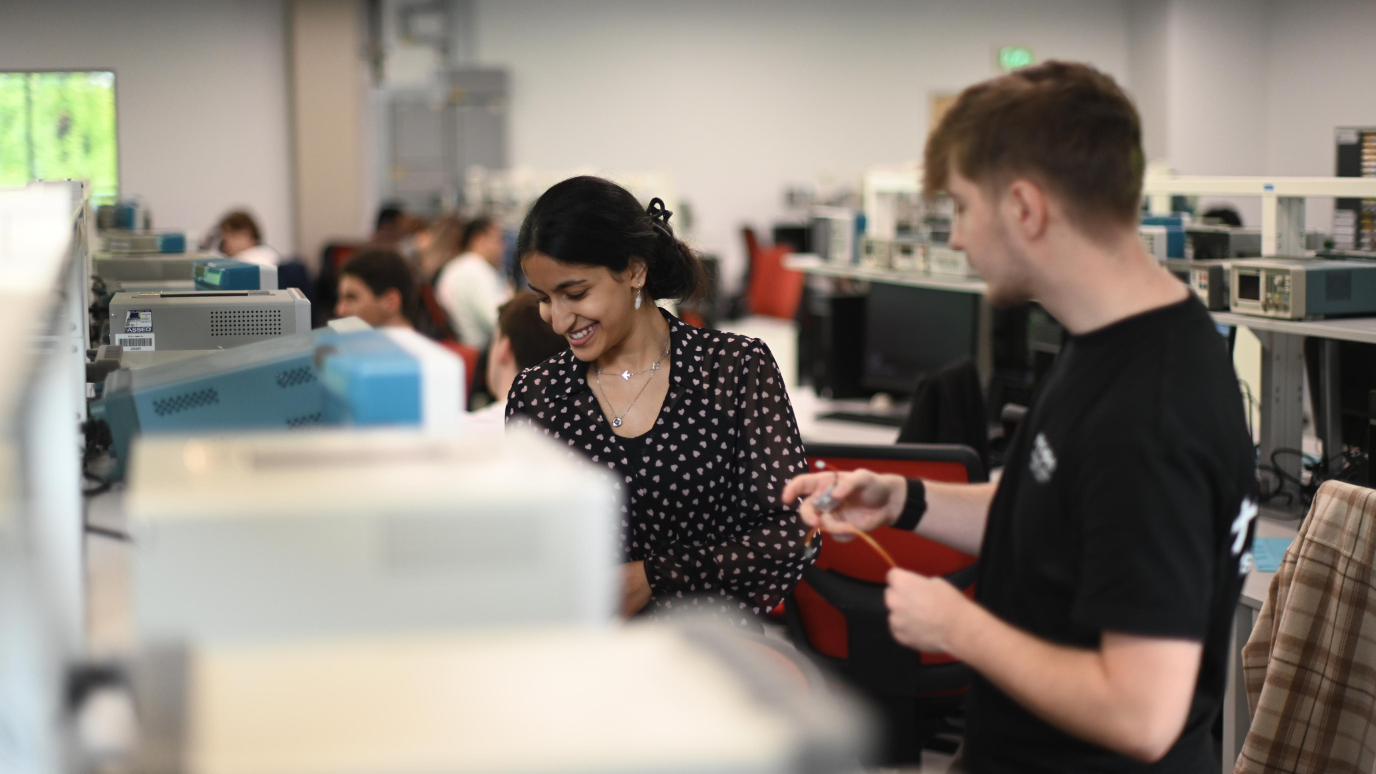
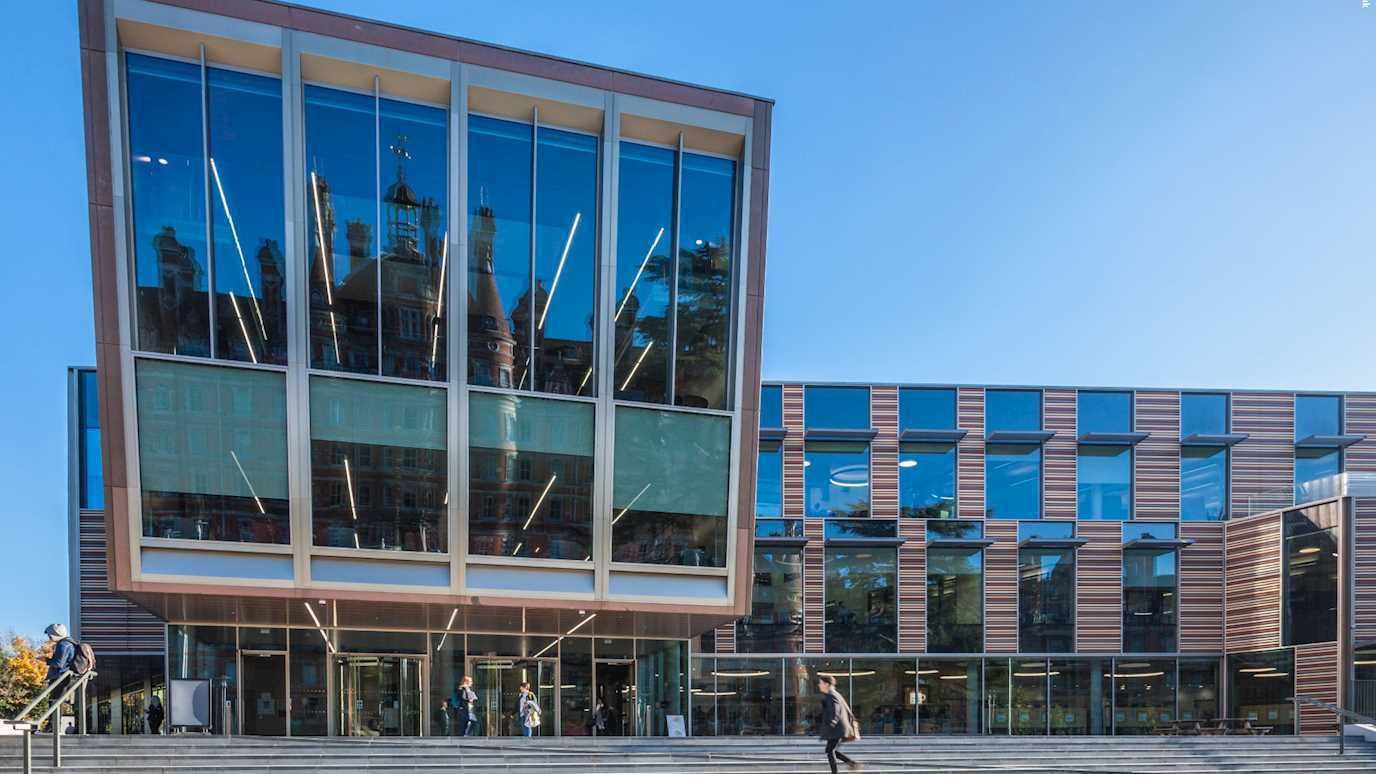
- Learn in a building that is purpose-built to support electronic engineering processes.
- Develop your interests through a number of optional modules in your final year.
- Graduate with high employability prospects in a thriving industry.
We sometimes make changes to our courses to improve your experience. If this happens, we’ll let you know as soon as possible.
Course structure
Core Modules
Year 1
-
Embedded Systems Creative Team Project 1
Working in groups, you will carry out a project using methods and techniques that parallel industrial practice. You will develop prototypes which solve one or more elements of a given issue. You will look at digital logic in the context of combinational and sequential logic with discrete logic gate circuits (AND, NOT, OR, NAND, XOR, XNOR) and consider how their responses can be modelled in practice using Boolean algebra, truth tables, De Morgan's theorem and Karnaugh maps. You will also become familiar with the professional team working attitudes and skills required to take projects from inception to the fabrication of a final product prototype.
-
Programming in C++
In this module you will develop an understanding of programming in C++. You will learn how to use mathematical and computer-based models to solve electronic engineering problems and how to apply quantitative methods in C++. You will look at the concept of a computer program and compilation in the context of objective-orientated programming, and examine the digital representation of numbers, user interfacing, printing to screen, iterative and conditional statements, and error handling.
-
Electronic Circuits and Components
The aim of this module is to provide theoretical and practical knowledge of electronic components and their use in circuits. This module covers the electrical properties of both passive (including resistors, capacitors, inductors) and active electronic components (including diodes, photo diodes, LEDs, transistors, ICs, opto-isolators, opto-couplers) and how they are typically used in practical circuits during laboratory sessions. The design and analysis of analogue circuit behaviour is covered in the context of the use of phasors to represent voltage-current phase differences, transient and steady-state design and analysis of passive and active filters, time and frequency domain representations of the small signal responses of amplifier circuits.
-
Communications Engineering 1
The aim of this module is to provide an introduction to the theoretical and practical knowledge of communications engineering. In terms of indicative content, this module will include the description of a signal and its characterisation in the time and frequency domains, considerations, introduction to analogue and digital signals; linear time invariance, random variables, Gaussian random processes, probability, thermal noise; introduction to modulation techniques including RF modulation, spectral and power considerations, pre-emphasis and de-emphasis, baseband recovery, error detection and correction, PLLs, multiplexing; introduction to digital signal transmission including sampling theorem, a2d and d2a conversion and quantisation, numbers of bits, error bit probabilities, introduction to digital signal processing.
-
Mathematics for Engineers 1
In this module you will develop an understanding of how to solve problems involving one variable (either real or complex) and differentiate and integrate simple functions. You will learn how to use vector algebra and geometry and how to use the common probability distributions.
-
Mathematics for Engineers 2
In this module you will develop an understanding of how to solve problems involving more than one variable. You will learn how to use matrices and solves eigenvalue problems, and how to manipulate vector differential operators, including gradient, divergence and curl. You will also consider their physical significance and the theorems of Gauss and Stokes.
-
Internet Services
In this module you will develop an understanding of how the internet works and its key protocols. You will look at the technologies used for web development, including scripting languages and their potential for adding dynamic content to web sites and applications. You will consider the role of web services and related technologies, and will examine the fundamental principles of network security.
Year 2
-
Embedded Systems Creative Team Project 2
In this module you will move from prototype design to product creation. Working in groups, you will take on a specific management function within the context of industrial practice. You will use the results of analysis and apply technology by implementing engineering processes to solve engineering problems. You will demonstrate the ability to use relevant materials, equipment, tools, processes or products and use creativity and innovation in a practical context to establish an innovative solution.
-
Computer and Network Security
In this module you will develop an understanding of computer and network security. You will look at software vulnerabilities, hands-on hacking-oriented attacks, memory errors, and web and network security. You will learn how to identify such vulnerabilities and consider the countermeasures that can mitigate their exploitation. You will also examine malicious software (malware) as a typical consequence of a successful software exploitation.
-
Introduction to Information Security
In this module you will develop an understanding of how information security may be influenced by real-world design and implementation decisions. You will look at the different cryptographic algorithms, considering their use, advantages and disadvantages. You will use these cryptographic primitives to review and evaluate cryptographic protocols, and examine the rational decisions in the design of tokens and secure elements.
-
Software Engineering for Electronics
The aim of this module is to provide theoretical and practical knowledge of software engineering for electronics. This module introduces software engineering processes including the software lifecycle and the techniques used to produce and manage complex, fit-for-purpose, safe, large, cost-effective software systems in practice from both a technical and non-technical point of view. The concepts of software design, analysis and creation will be explored in the context of real-world examples and software architectures.
-
Signals, Systems and Communications
The aim in this module is to understand the mathematical interactions that the combination of various system types impose upon signals and their conveyance in communication applications, quantifying the interplay of deterministic cost factors such as bandwidth, energy, power and interference.
-
Professional and Sustainable Engineering
This module introduces the full and holistic life cycle analysis in relation to electronic products and components, their environmental impact and sustainability. You will develop an understanding of closed loop technology renewable and sustainable technologies and challenges, motivators for sustainable engineering and the notion of ‘green engineering’. Ethical and social impact of engineering and technology will be covered together with real-world case studies.
-
Algorithms and Complexity
In this module you will develop an understanding of the design of algorithms, with a focus on time and space complexity. You will examine basic algorithms, looking at the implementation and analysis of linear search, binary search, and basic sorting, including insertion sort, selection sort, merger sort, quick sort, and heap sort. You will consider alternative data structure representations, such as binary search trees, hash tables, and binary heaps, and will gain an insight into the basics of graph algorithms.
Year 3
-
Individual Project
In this module you will engage in theoretical and practical work on an agreed specific area relevant to electronic engineering. This will usually be a prototype that demonstrates the feasibility of a product or a fully functioning prototype depending on the nature of the topic itself. You will be allocated a supervisor and progress will be monitored against the specification in terms of implementation and testing as appropriate.
-
Digital Signal Processing Design
In this module you will develop an understanding of the scientific principles underpinning practical signal processing. You will look at the mathematics behind signal processing and consider new and emerging technologies within the field. You carry out practical work in digital filter design involving the use of MATLAB.
-
Principles of Engineering Management
In this module you will develop an understanding of modern techniques used in company management to tackle the challenges of the business sector. You will look at company management structures, company finance, statuary requirements, human resource management, project management techniques, managing risks, health and safety requirements, and how to deal with problems that arise during the project lifecycle. You will consider the role of codes of practice and industry standards, and examine relevant legal requirements governing engineering activities.
-
Digital Systems Design
This course module will help you develop your knowledge and understanding of advanced digital systems design. You will learn the principles of designing digital logic circuits, hardware description languages and control unit design, acquire the skills to design controllers from written specifications, and evaluate and make decisions about specific digital system designs.
-
Advanced Communications Systems
Recent years have seen a rapid growth of bandwidth intensive voice, video and data applications (high-speed internet, video streaming services and satellite communications). Microwave and optical communication technologies will be pivotal in the delivery of next generation of high-speed networks and thus critical knowledge of these systems is vital to engineers required to deliver these services in the future. This module aims to develop knowledge and understanding in advanced communications systems, principally modern microwave, optical and broadband technologies. At the end of this module, students will be able to analyse complex microwave systems using mathematical and computational tools, for example, estimating satellite link budgets. Further, they will be able to breakdown and categorise different elements of a complete communication system including, for example, high-speed optical data network architectures. Radio propagation will be studied along with the design principles of advanced microwave systems and inherent sources of degradation, distortion and losses. Finally, students will be introduced to the latest CAD tools for the evaluation and synthesis of practical microwave systems.
Year 4
-
Year in Industry
You will spend this year on a work placement. You will be supported by the Department of Electronic Engineering and the Royal Holloway Careers and Employability Service to find a suitable placement. This year forms an integral part of the degree programme and you will be asked to complete assessed work. The mark for this work will count towards your final degree classification.
Year 5
-
Team Project
In this module you will work on a practical problem relevant to tomorrow's societal needs. Working in groups, you will classify the performance of systems and components through the use of analytical methods and practical modelling techniques in the context of your chosen project topic. The working practice of your group will be modelled on industrial practices in terms of planning, keeping proper records of meetings and the progress of work, and you will take on an individual role within the team that is vital to the professional and successful running of the project. You will compare and assess different design processes and methodologies and working successfully as a group member you will exercise initiative, leadership, time management and professional decision-making skills.
-
Agile Engineering
This module is an introduction to the design needs and software/hardware solutions to modern immersive capture, storage, mixing, rendering and presentation systems. Students will learn how VR/AR systems are constructed and the audio visual technology behind them.
Optional Modules
Below is a taster of some of the exciting optional modules that students on the course could choose from during this academic year. Please be aware these do change over time, and optional modules may be withdrawn or new ones added.
Year 1
-
All modules are core
Year 2
-
All modules are core
Year 3
-
Fundamentals of Biomedical Engineering
In this module you will develop an understanding of the human factors in healthcare engineering. You will look at critical safety issues in healthcare engineering and material compatibility in the context of implantable devices. You will consider the operation of systems such as eye trackers, hearing aids, cochlear implants, pacemakers, wearable health monitors and examine the role of assistive technologies, electronic enhancement for condition diagnosis, medical robots and drug delivery control.
-
Power Systems
In this module you will develop an understanding of a range of renewable energy generation concepts. You will look at technologies such as wind generators, solar generation, hydro and marine generation concepts, geothermal dynamics and biofuels. You will consider the different sources of primary energy as well as the energy conversion and electricity generation principals that are exploited. Using your engineering skills, you will build your own renewable micro-generators.
-
AI on Chip
The module introduces the fundamental principles of Artificial Intelligence (AI) and Machine Learning (ML), with a particular emphasis on their deployment in embedded systems at the edge (CPUs/FPGAs). It explores the key stages of building an on-chip AI system, including data preprocessing, feature selection, ML algorithms training and embedded system modelling for direct implementation on edge devices.
Students will gain practical knowledge of various ML algorithms, such as Artificial Neural Network (ANNs) and Convolutional Neural Networks (CNNs), in the context of specific applications (such as computer vision). The module also covers strategies for optimizing AI models (such as quantization or hardware aware neural architectures) to run efficiently on edge compute systems. -
Quantum Computing
This module aims to introduce the fundamentals of quantum formalism, and the mathematical tools necessary for quantum computing, eg, complex numbers and linear algebra, which are the building blocks for quantum computing. In addition, the module will cover the basic principles of quantum mechanics, with a particular focus on qubits, their time evolution, and measurements. The focus will then be on the circuit model of quantum computation, which is the standard way to describe quantum algorithms. The goal is to enable students to apply quantum mechanical rules to circuits comprised of multiple qubits. Also to learn some basic algorithms and compare them to their classical counterparts, demonstrating the advantage of quantum over classical computing. By the end of the module, students will be equipped with the necessary skills and knowledge to build and analyse quantum circuits.
-
Machine Learning
In this module you will develop an understanding of key methods and techniques in machine learning. You will study approaches such as nearest neighbours, ridge regression, Lasso, and support vector machines for both classification and regression tasks. You will explore the use of different distance measures and the kernel trick, as well as practical kernels and their applications. The module also introduces conformal prediction and its application to various algorithms. You will gain experience in implementing basic machine learning algorithms and develop an awareness of how these methods can be applied in fields such as industry and medicine.
-
Critical Infrastructure Security
The module covers key areas of cyber security with the critical national (information) infrastructure forming its background. Fault and attack models for information systems and cyber-physical systems are covered in the form of multiple techniques including variants of attack trees allowing probabilistic attack and defence refinements. The module covers models of large-scale networks and their robustness properties to both random failures and particularly to deliberate attacks and discusses how key elements of the CNI such as the Internet but also other infrastructure sectors such as power and transport sectors can be captured by such models. The security of cyber-physical systems and particularly industrial control systems is another major component of the module, including case studies of attacks by state actors and analyses of control system protocols as well as properties peculiar to CPS.
-
Digital Forensics
Digital forensics has evolved considerably from its origins in the 1970s, where it focused on recovering data from standalone systems, into a dynamic field that spans across different electronic devices to cloud platforms, networked environments, and emerging technologies such as the Internet of Things (IoT). As digital evidence plays an increasingly vital role in legal and regulatory contexts, the demand for skilled forensic practitioners continues to grow.
This module addresses that demand by integrating core forensic principles with contemporary tools and techniques, including the application of Artificial Intelligence (AI) in evidence analysis. Students will develop the theoretical knowledge, practical skills, and critical thinking necessary to investigate complex digital environments.
The module offers a blended learning experience that supports a progressive understanding of digital forensic investigation through a mix of lectures, seminars, and hands-on labs. All legal and ethical considerations are integrated throughout the curriculum, ensuring that students are adequately prepared to present digital evidence within relevant contexts.
Year 5
-
Pattern Recognition
This module provides theoretical and practical knowledge relating to pattern recognition. Topics will include Bayesian decision theory, Artificial Neural Networks and Support Vector Machines (amongst others). The nature of these algorithms will be studied along with engineering techniques for developing smart applications. Further, deep learning for engineering applications (eg. classification of electrocardiograms) will be studied and you will undertake coursework to apply an appropriate machine learning methodology to solve a real-world pattern recognition problem.
-
System on Chip Design
The module extends the knowledge acquired in digital systems with advanced topics in the emergent area of FPGA based system on chip design. The module will cover state-of-the-art features available in modern FPGAs exploring their fine-grained internal architecture and embedded macro blocks such as DSP slices, IPs and hardcore/softcore processors. A design language based on C/C++ will be presented as an alternative to traditional RTL design (VHDL). High level synthesis tools will be used to compute signal processing applications.
-
Security Management
This security management module explores how effective information security management works within organisations and across society. It engages with established information security management standards and texts, scenario-based investigation, and critical analysis, a foundation is provided to identify the opportunities and challenges of information security management. The module is delivered through 11 core three-hour lectures using a combination of security practitioners, information managers and academics. In addition to the taught material, there is an expectation that students will take part in an online discussion forum as well as complete appropriate private study.
-
Security Testing Theory and Practice
This module will provide the foundations and theoretical underpinnings for an understanding of the way in which IT systems can be attacked and penetrated by circumventing security or exploiting vulnerabilities in the system. This will form the basis of a methodical approach to surveying and auditing systems, and prepare candidates to design secure systems, identify vulnerabilities, and defend systems against intrusion. The course will cover the following topics: (a) Security testing frameworks and methodologies, and how to prepare, manage and conduct a professional penetration testing; (b) An overview of legal aspects involved when performing a penetration testing; (c) Technical aspects of network security covering standards, protocols, routing, firewalls showing the theoretical basis of vulnerabilities and how these may be exploited in practice; (d) Technical aspects of computer security covering operating systems, access control in Windows and Unix-like systems, host based intrusion detection, escalation of privileges and how to exploit these vulnerabilities in practice and how to harden systems; (e) Technical aspects of Internet based applications, web services, protocols, languages (e.g. SQL) and how these may be exploited using for example SQL injection and cross-site scripting; how to exploit these vulnerabilities in practice, and how to mitigate these vulnerabilities.
-
Mobile and Optical Fibre Communications
The main aims of the module are to provide guidance and experience of working in Mobile and Fibre Optic high-speed smart communication systems ensuring that user requirements are understood and used to produce suitable advanced solutions. Students will acquire knowledge of fundamental concepts, terminology, techniques, and principles: Radio over Fibre (RoF) components; causes and techniques to remove radio frequency interference; optical multiplexing and switching technologies; link budget calculation; optical network architectures; increased dynamic range. Furthermore, students will be exposed to the importance of RoF systems in the broadband mobile and fibre telecommunication systems, where they are used for applications such as fibre optics, microwave and photonic components, antenna remoting, radar detection, satellite communications, signal generation, and electronic warfare systems. Students will interact with leading UK communication industries and learn from experienced communication leaders on how to apply communication engineering skills to real-world problems.
-
Sustainable Power
The aims of this module are to cover the wide variety of renewable generation concepts. This module will be updated each year to reflect new developments in this fast moving field. Students are encouraged to investigate independently into new generation technologies. The aim of this course will be to give students the opportunity to apply their creative engineering skills in order to think of new generation concepts. Lectures will cover many different forms of renewable generation in detail. Large scale, embedded as well as micro-generation will be discussed. Technologies include, but are not limited to wind generators, solar generation, hydro and marine generation concepts, geothermal and biofuels. Any other generation types which are classified as renewable will also be included, to gain a detailed understanding of various renewable technologies, and the different sources of primary energy as well as the energy conversion and electricity generation principles that are exploited. The learning is reinforced in the lab sessions, when students use their engineering skills to build renewable micro-generators based on their own ideas and designs to demonstrate a comprehensive understanding of the scientific principles of renewable energy and related disciplines.
-
User-Centred Design
This module focuses on user-centred design aspects and challenges in interactive traditional, augmented and virtual reality contexts, and addresses the approaches that can be used to create displays and interfaces to enhance user experience.
Module content:
- Background: Human-Computer Interaction and Human Performance (definition and history);
- User experience (UX) vs. user interface (UI);
- Fundamentals of perception and cognition in design;
- Human workload and automation;
- Auditory perception and attention (creating a multisensory experience);
- Psychological considerations in virtual and augmented reality;
- Heuristic evaluation;
- Rapid prototyping;
- HCI studies/experiments.
Teaching & assessment
Teaching activities will include lectures, workshops and seminars and practical project work will be carried out in groups and individually in purpose-built thinking, prototyping and fabrication laboratories. In particular, the underlying principles of the course are the exploitation and development of creative skills in the context of proposing ingenious solutions to emerging problems prior to the prototype and product development stages.
Various assessment methods will be used including examinations for theoretical subjects, formal presentations, reports and practical demonstrations for project work with an additional viva voce examinations for final year individual projects. In addition, you will be involved in workshops and will produce various forms of creative work.
Entry requirements
A Levels: AAB-ABB
Required subjects:
- A-level in Mathematics
- We require English Language and Mathematics GCSE at grade 4/C
HL 665 (without Diploma) or 34 overall (with Diploma)
EUROPEAN BACCALAUREATE 80%
If you have completed Secondary or High School in this country then you will need to take our one year International Foundation Year , or the equivalent from another institution, before beginning your undergraduate studies.
If you have completed Secondary or High School in this country then you will need to take our one year International Foundation Year , or the equivalent from another institution, before beginning your undergraduate studies.
Year 12 High School Certificates: ATAR: 90, Queensland OP: 4
Reifezeugnis/Maturazeugnis: 1.5
If you have completed Secondary or High School in this country then you will need to take our one year International Foundation Year , or the equivalent from another institution, before beginning your undergraduate studies.
Bachelor degree studied for 2 years or less than 3: GPA of 3.25
Certificate D Enseignement Secondaire Superieur (CESS) (score out of 10) or Diploma van Hoger Secundair Onderwijs (score out of 20): 8/10 or 17/20 or 70%
Secondary School Leaving Diploma: 4/5
Diploma za Sredno Obrazovanie 5.6
Year 12 High School Graduation Diploma: 86%
National College Entrance Examination (NCEE) (Gaokao): 75%
Svjedodzba o Maturi: Overall grade of 5
Apolytirion of Lykeion: Average of 18.5 in Apolytirion
Maturitni Zkouska / Maturita: 1.8
Bevis for Studentereksamen or Hojere Forberedelseseksamen (HF) or Hojere Handelseksamen (HHX) / Hojere Teknisk Eksamen (HTX): Average grade of 10
Certificate of Nile Secondary Education (CNISE) Level 3: AAB
Gumnaasium Ioputunnistus (Secondary School Certificate) with Riigieksammid (state exams): 4.5 in Gumnaasium Ioputunnistus and 80% in Riigieksamid
Ylioppilastutkinto / studentexamen: EMMM
Baccalaureat / International Option Baccalaureate (OIB): 13/20
Zeugnis der Allgemeinen Hochschulreife / Abitur: 1.5
If you have completed Secondary or High School in this country then you will need to take our one year International Foundation Year , or the equivalent from another institution, before beginning your undergraduate studies.
Apolytirion of Lykeion: Average of 18.5 in Apolytirion
Achieve grades 5,5,4 overall in your Hong Kong Diploma of Secondary Education with a grade 5 in any A-level subject specified above
Achieve a grade of 4.7 overall in your Erettsegi / Matura with a grade 5 in any A-level subject specified above
Achieve a grade of 8.5/10 overall in your Studentsprofwith a grade 9 in any A-level subject specified above
Achieve a grade of 80% overall in your Higher Secondary School Certificate with 80% in any A-level subject specified above
If you have completed Secondary or High School in this country then you will need to take our one year International Foundation Year , or the equivalent from another institution, before beginning your undergraduate studies.
Achieve a grade of 16/20 or 80% overall in your National Entrance Examination (Konkur) with a grade 16 or 80% in any A-level subject specified above
If you have completed Secondary or High School in this country then you will need to take our one year International Foundation Year , or the equivalent from another institution, before beginning your undergraduate studies.
Achieve a grade of 8/10 overall in your Bagrut with a grade 8 in any A-level subject specified above
Achieve a grade of 90 overall in your Esame di Stato with a grade 18/20, 14/15 or 9/10 in any A-level subject specified above
If you have completed Secondary or High School in this country then you will need to take our one year International Foundation Year , or the equivalent from another institution, before beginning your undergraduate studies.
Nazarbayev Intellectual Schools (NIS) Grade 12 Certificate: ABB
If you have completed Secondary or High School in this country then you will need to take our one year International Foundation Year , or the equivalent from another institution, before beginning your undergraduate studies.
Achieve a grade of 4 overall in your Diplome per Kryerjen e Shkolles se Mesme te Larte with a grade 5 in any A-level subject specified above
If you have completed Secondary or High School in this country then you will need to take our one year International Foundation Year , or the equivalent from another institution, before beginning your undergraduate studies.
Achieve a grade of 9.0 overall in your Atestats par visparejo videjo izglitibu with a grade 9.5 in any A-level subject specified above
If you have completed Secondary or High School in this country then you will need to take our one year International Foundation Year , or the equivalent from another institution, before beginning your undergraduate studies.
Achieve a grade of 5/6 overall in your Matura with a grade 5 in any A-level subject specified above
Achieve a grade of 9.0 overall in your Brandos Atestatas with a 9/90% in any A-level subject specified above and at least 85% in three state exams
Achieve a grade of 44 overall in your Diplome de Fin d'Etudes Secondaires with 48 in any A-level subject specified above
Achieve grades AAB in your Sijil Tinggi Persekolahan Malaysia with a grade A in any A-level subject specified above
Achieve grades AAB in your Advanced Matriculation with grade A in any A-level subject specified above
Achieve AAB in the Cambridge Overseas Higher School Certificate/General Certificate of Education Advanced Level with grade A in any A-level subject specified above.
Achieve AAB in the Cambridge Overseas Higher School Certificate (COHSC) with grade A in any A-level subject specified above.
Achieve a grade of 8 overall in your Voorbereidend Wetenschappelijk Onderwijs (VWO) with a grade 7 in any A-level subject specified above
Achieve a grade of Excellence overall from three subjects in your NCEA level 3 with a grade of Excellence in any A-level subject specified above
If you have completed Secondary or High School in this country then you will need to take our one year International Foundation Year , or the equivalent from another institution, before beginning your undergraduate studies.
Achieve a grade of 4.8 overall in your Matura with a grade 5 in any A-level subject specified above
Achieve a grade of 75% overall from the final two years of your Devlet Lise Diplomasi or Lise Bitirme Diplomasi with a grade.
Achieve a grade of 4 plus 5 in at least one related subject overall in your VVO with a grade 5 in any A-level subject specified above
If you have completed Secondary or High School in this country then you will need to take our one year International Foundation Year , or the equivalent from another institution, before beginning your undergraduate studies.
If you have completed Secondary or High School in this country then you will need to take our one year International Foundation Year , or the equivalent from another institution, before beginning your undergraduate studies.
Achieve a grade of 75% overall in your Matura including 75% in three extended level subjects with a grade of 80% in any A-level subject specified above
Achieve a grade of 17 overall in your Certificado de fim de Estudos Secundarios with grades 18,18,17 in 3 year 11 or 12 exams with 18 in any A-level subject specified above
If you have completed Secondary or High School in this country then you will need to take our one year International Foundation Year , or the equivalent from another institution, before beginning your undergraduate studies.
Achieve a grade of 8 overall in your Diploma de Bacalaureat with a 9 in any A-level subject specified above
If you have completed Secondary or High School in this country then you will need to take our one year International Foundation Year , or the equivalent from another institution, before beginning your undergraduate studies.
If you have completed Secondary or High School in this country then you will need to take our one year International Foundation Year , or the equivalent from another institution, before beginning your undergraduate studies.
Achieve a grade of 4.5 overall in your Secondary School Leaving Diploma with a grade 4 in any A-level subject specified above
Achieve a GPA of 3.0 overall in your Singapore Polytechnic Diploma with a GPA of 3.5 in any A-level subject specified above
Achieve a grade of 1.5 overall in your Maturita with a grade 1.5 in any A-level subject specified above
Achieve a grade of 4 overall in your Matura with a grade 5 in any A-level subject specified above
Achieve grades 66655 in at least 6 subjects overall in your National Senior Certificate (state board) or 65555 (IEB board)
If you have completed Secondary or High School in this country then you will need to take our one year International Foundation Year , or the equivalent from another institution, before beginning your undergraduate studies.
Achieve a grade of 8 overall in your Titulo de Bachillerato with a grade 8 in any subject specified above
If you have completed Secondary or High School in this country then you will need to take our one year International Foundation Year , or the equivalent from another institution, before beginning your undergraduate studies.
Achieve a grade of AAB overall in the Advanced Certificate of Secondary Education (CSEE) with a grade A in any subject specified above.
If you have completed Secondary or High School in this country then you will need to take our one year International Foundation Year , or the equivalent from another institution, before beginning your undergraduate studies.
Achieve a grade of 75% overall from the final two years of your Devlet Lise Diplomasi or Lise Bitirme Diplomasi with a grade of 70% in any subject specified above
Achieve AAB in the Ugandan Advanced Certificate of Education (UACE) with a grade A in any subject specified above.
If you have completed Secondary or High School in this country then you will need to take our one year International Foundation Year , or the equivalent from another institution, before beginning your undergraduate studies.
If you have completed Secondary or High School in this country then you will need to take our one year International Foundation Year , or the equivalent from another institution, before beginning your undergraduate studies.
Achieve a grade of 4 in at least two relevant AP Examinations; or a composite score of 26 in the ACT Examinations (including the ACT writing test) with an AP grade 4 or College Class B in any A-level subject specified above; or SAT 1100 with an AP grade 4 or College Class B in any A-Level subject specified above.) Please note AP Calculus BC required for Computer Science and Electronic Engineering, or a relevant college class.
Achieve a grade of 18.5 or B overall in your Avgangsbetyg / Fullstandigt Slutbetyg fran Gymnasieskolan with a grade A in any subject specific above
If you have completed Secondary or High School in this country then you will need to take our one year International Foundation Year , or the equivalent from another institution, before beginning your undergraduate studies.
Achieve a grade of 112 overall at the two unit level in your Caribbean Advanced Proficiency Examination with a grade 1 in any subject specified above.
English language requirements
All teaching at Royal Holloway is in English. You will therefore need to have good enough written and spoken English to cope with your studies right from the start.
The scores we require
- IELTS: 6.5 overall. No subscore lower than 5.5.
- Pearson Test of English: 67 overall. No subscore lower than 59.
- Trinity College London Integrated Skills in English (ISE): ISE III.
- TOEFL iBT: 88 overall, with Reading 18 Listening 17 Speaking 20 Writing 17.
- Duolingo: 120 overall and no sub-score below 100.
Country-specific requirements
For more information about country-specific entry requirements for your country please visit here.
Undergraduate preparation programmes
For international students who do not meet the direct entry requirements, for this undergraduate degree, the Royal Holloway International Study Centre offers the following pathway programmes designed to develop your academic and English language skills:
- International Foundation Year – for progression to the first year of an undergraduate degree
- International Year One - for progression to the second year of an undergraduate degree
Upon successful completion, you can progress to this degree at Royal Holloway, University of London.
Your future career
This degree will equip you with the technical knowledge, practical skills and confident verbal and written communication abilities, as well as transferable decision making skills in new, complex and unpredictable situations in industrial team working, with your experience gained working in an industrial environment. You will graduate with a skillset that will fully meet the demands required for employment in industry, including the development of new ideas, and experience in the application of creativity in solving computer systems engineering problems. You will acquire an awareness of environmental and social issues, investigating new materials and using them in ways that have a beneficial effect on humanity.
Fees, funding & scholarships
Home (UK) students tuition fee per year*: £9,790
The fee for your year in industry will be 20% of the tuition fee for that academic year.
EU and international students tuition fee per year**: £29,900
The fee for your year in industry will be 20% of the tuition fee for that academic year.
Other essential costs***: There are no single associated costs greater than £50 per item on this course.
How do I pay for it? Find out more about funding options, including loans, scholarships and bursaries. UK students who have already taken out a tuition fee loan for undergraduate study should check their eligibility for additional funding directly with the relevant awards body.
*This figure is the fee for Home (UK) undergraduates on this course for the academic year 2026/27 and is controlled by Government regulations.
**This figure is the fee for EU and international students on this course in the academic year 2026/27.
Royal Holloway reserves the right to increase tuition fees annually for all students. For further information see fees and funding.
*** These estimated costs relate to studying this particular degree at Royal Holloway during the 2026/27 academic year. Refers to specific individual items of £50 or more, and excludes accommodation, commuting, food, books/other learning materials and printing costs.