Languages For All is transforming language education, expanding access to A-level study and inspiring more young people to pursue languages and access global careers

What are the benefits of learning another language?
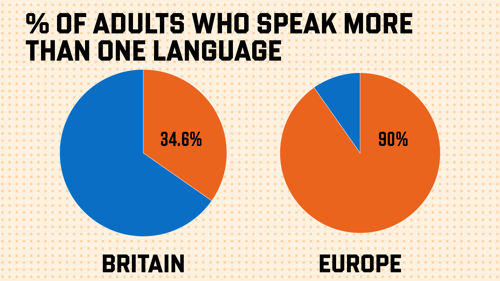
In our increasingly multicultural world, languages can be an incredible gateway to better communication and cultural enrichment, yet in the UK only 34.6% of adults speak another language. This is in stark contrast to the rest of Europe, where over 90% of adults in most countries speak multiple languages. Despite research indicating that one in four adults in the UK regret not learning another language, the number of people studying a modern language at A-level has declined by 21.2% in the last two decades.
Professor Ruth Hemus of Royal Holloway University wants to reverse this decline.
Since 2023 she has been working in partnership with independent educational charity The Reach Foundation, on a project called Languages For All, that aims to increase the number of students studying modern languages at A-level and at university.
“Languages are more important than ever in building understanding and bridging divides. We have a shared purpose to promote the opportunities that languages can bring.” - Ruth Hemus
Making language learning more accessible
Royal Holloway and colleagues from The Reach Foundation identified two main barriers that were turning students away from language study.
1. Attitude |
Students aren’t always aware of how a language A-level could benefit them in their future careers. Yet evidence shows that language skills and cultural competence can help people stand out in the job market, leading to a higher salary and more career opportunities. |
To help students see these benefits in action, we devised the Global Languages Ambassador Award, a qualification awarded to students who undertake a series of activities.
The students go on trips to campus, visit potential employers, and travel abroad to the countries that speak their chosen languages. These activities illustrate some of the doors that learning a language could open for them, and they meet people who have taken similar journeys.
2 - Cost |
Not for the students, but for the institutions. Because A-level Modern Languages courses have smaller class sizes, the classes are more expensive to run. |
‘Languages For All’ creates ‘hubs’ of schools and colleges, who can share teachers and resources, allowing students to study a language even if their closest college doesn’t offer it. Schools can sign students up for after-school and online A-level tuition, to make learning a language possible. Finally, student linguists from Royal Holloway can sign up as ‘Languages For All’ Ambassadors. In these roles they provide additional speaking practice in schools to help prepare pupils for exams.
Although ‘Languages For All’ is designed to mainly benefit students, it also benefits both internal and external stakeholders, including secondary school and college teachers and university staff.

Already making a difference
In the first three years that ‘Languages For All’ has been running, there have already been tangible benefits.
Students who took part in the programme were able to better understand how languages could help their futures. Before taking part, 61% of the students said that they understood how languages could help them. After taking part, the number of students reporting this rose to 80%.
One 16-year-old student shared that she “learnt the value of languages in all career fields and how they unlock opportunities to immerse yourself in foreign cultures and make lasting memories. It’s rewarding to realise that learning other languages is not just a skill but also a way to connect with others, show respect, and build relationships.”
In Hounslow, where the partnership with Royal Holloway first began:
- The number of state schools offering modern languages at A-level has tripled, from four in 2022, to 12 in 2025.
- The number of students in these courses also doubled, from 35 in 2022 to 70 in 2025.
- Of these students, 39% said that they planned to continue their language studies at university.
Royal Holloway looks forward to welcoming the first linguists to have completed a three-year cycle of the project in 2026.
Where next
This is all measurable proof that 'Languages For All' works – but there’s still much more to do.
A similar model has now been adopted by the University of Exeter in the Devon/Cornwall area. Further schemes are planned, including with the University of Leeds in the North, directly inspired by and in partnership with the now-established ‘Languages For All’ organisation.
Ruth hopes that the success that’s already been shown by the Royal Holloway/Hounslow partnership will encourage even more universities and educational institutions in the UK to adopt the model.
“We have a shared vocation to make language learning appealing and accessible.”

News about the launch of the project:
Languages for all launch. . . . . . . . . .
Return to our Research in Focus page to uncover more exciting research happening at Royal Holloway, University of London.
Research in Focus homepage