Mary Wollstonecraft’s Maria: Or, The Wrongs of Woman (1798): anti-coverture rhetoric prior to Caroline Norton. This is an edited excerpt from a dissertation produced as part of the MA English Literature
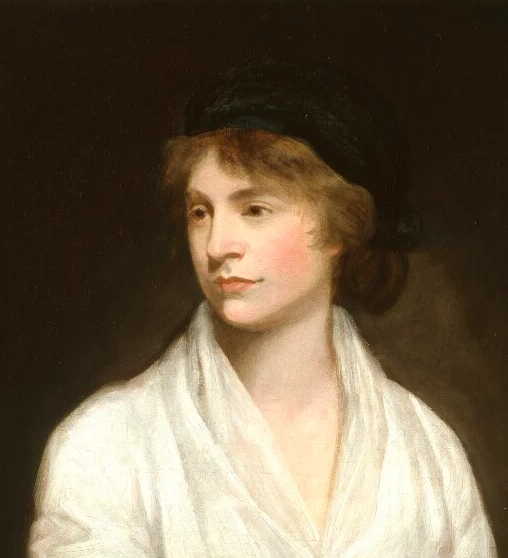
John Opie. Mary Wollstonecraft. C. 1797. National Portrait Gallery, https://www.npg.org.uk/collections/search/portrait/mw02603/Mary-Wollstonecraft.
From the twelfth century through to the latter decades of the nineteenth century, married women in England were denied economic and legal rights due to a common law principle known as coverture. Literally meaning ‘covering’, coverture considered married women to be covered by their husbands’ legal identities, leaving them without the need for their own. William Blackstone, an English jurist and politician, famously described this principle in his Commentaries on the Laws of England, published throughout the 1760s: “the husband and wife are one person in law: that is, the very being or legal existence of the woman is […] incorporated and consolidated into that of the husband: under whose wing, protection and cover, she performs everything” (430).
The consequences of coverture for married women were substantial: as Tim Stretton and Krista Kesselring note, “A woman’s movable property — her money, livestock, and personal possessions — became her husband’s outright. He had total control over any cash she brought to [their] marriage or inherited or earned thereafter” (8). Coverture was ultimately abolished by a series of legal reforms passed throughout the latter decades of the nineteenth century and the early decades of the twentieth. Notably, the Married Women’s Property Acts — passed in 1870, 1882, 1907 and 1964 — granted married women increased (eventually full) property rights.
A key figure in the abolition of coverture was Caroline Norton (1808-1877). In 1836, Norton separated from her husband. In the years following this separation, Norton penned numerous political pamphlets denouncing the laws of coverture. Those laws both prevented her from divorcing her husband and gave him full rights to her property even after their separation. Norton’s campaigning, particularly her 1855 pamphlet, A Letter to the Queen on Lord Chancellor Cranworth’s Marriage and Divorce Bill, is thought to be indirectly responsible for the passage of the first of the Married Women’s Property Acts (Poovey 21).
Norton currently functions as the cornerstone for literary scholars’ discussions of coverture in fiction, providing the contextual framework against which scholars read their chosen novels (as seen in studies by Elisabeth Rose Gruner, Cheri Hoeckley, and Bradley Tepper). These studies predominantly focus upon works of fiction produced in the mid-nineteenth century, when Norton was actively campaigning. This misrepresents the discourse on the abolition of coverture as one contained to the decades immediately predating reform. In actuality, this was a lengthy discourse which predated both Caroline Norton and the nineteenth century.
A pre-nineteenth century challenge to coverture is found in Mary Wollstonecraft’s unfinished novel Maria, Or: The Wrongs of Woman (1798). From Maria’s outset, the eponymous heroine’s marriage to George, the son of a successful merchant, is governed by the exchange of property: unbeknownst to Maria, in encouraging George to propose, her uncle promises the newlyweds £5,000. Following their marriage, Maria discovers this financial exchange and requests that George give her sisters “a thousand pounds a-piece” (Wollstonecraft 107).
Maria’s request corresponds with Stretton and Kesselring’s claim that, whilst coverture legally handed control of a household’s finances to the husband, many individuals held to an “optimistic assumption [...] that a married couple formed a team […] working towards the same ends” (9). As such, a husband might take advice from his wife regarding household expenses, recognising their shared interest in how the money was spent.
George’s reaction to Maria’s request reveals that he has no intention of taking Maria’s advice on family finances. Maria recounts, “He asked me, giving me a kiss, ‘If I had lost my senses?’” (Wollstonecraft 107). This repudiation exudes condescension. In conferring a kiss alongside his dismissal, George reveals to Maria what he seeks from his wife: not her opinions, but her body. Faced with this condescension, the first revelation of the inequality that will dominate their marriage, Maria instinctively draws her body away from George, as though he poses a tangible threat: “I started back, as if I had found a wasp in a rose-bush” (Wollstonecraft 107).
The £5,000 is spent paying off George’s creditors. At the time of the marriage, Maria and her uncle were unaware that George’s finances are in disarray. Upon discovering the extent of her husband’s debts, Maria laments that she was kept in ignorance over the £5,000 gift prior to her marriage. Had she known of her uncle’s intended gift, she claims,
I should have insisted on a thousand pounds being settled on each of my sisters; George would have contested; I should have seen his selfish soul; and — gracious God! have been spared the misery of discovering, when too late, that I was united to a heartless, unprincipled wretch. (Wollstonecraft 104)
Indeed, greed appears to be George’s sole motive in marrying Maria: any attentions which he pays her, both before and during their marriage, correspond to an imminent threat of pecuniary ruin. For George, proximity to Maria, and thus her wealthy uncle, is merely a financial lifeline.
Reflecting bitterly on her lack of options in the face of her husband’s greed, Maria produces an apostrophe verging on polemic: “a wife being as much a man’s property as his horse, or his ass, she has nothing she can call her own. He may use any means to get at what the law considers as his, the moment his wife is in possession of it” (Wollstonecraft 118). This description reveals the degradation Maria feels at her dispossession: she is dehumanised in the eyes of the law and her husband, of no greater value than a horse or ass.
Written in the 1790s, Maria anticipates the conclusion reached by the legal historians Stretton and Kesselring in 2013: that “coverture handed over to a recalcitrant or vindictive husband the keys to his personal kingdom” (10). As such, Wollstonecraft’s novel demonstrates the longevity of debates around the reform of married women’s property rights: fifty years before Norton’s A Letter to the Queen, and seventy years prior to the first Married Women’s Property Act, Wollstonecraft’s heroine explicitly lambasts the laws which denied married women any property rights.
Works Cited:
Blackstone, William. Commentaries on the Laws of England. Vol. 1, Oxford, Clarendon Press, 1765.
Gruner, Elisabeth Rose. “Plotting the Mother: Caroline Norton, Helen Huntingdon, and Isabel Vane.” Tulsa Studies in Women’s Literature, vol. 16, no. 2, 1997, pp. 303-25. JSTOR, https://www.jstor.org/stable/i219897.
Hoeckley, Cheri. “Anomalous Ownership: Copyright, Coverture, and Aurora Leigh.” Victorian Poetry, vol. 36, no. 2, 1998, pp. 135-61. JSTOR, https://www.jstor.org/stable/40003609.
Poovey, Mary. Uneven Developments: The Ideological Work of Gender in Mid-Victorian England. University of Chicago Press, 1988.
Stretton, Tim, and Krista Kesselring. “Introduction: Coverture and Continuity.” Married Women and the Law: Coverture in England and the Common Law World, edited by Tim Stretton and Krista Kesselring, McGill-Queen’s University Press, 2013, pp. 3-23.
Tepper, Bradley. Dragging the Chains of Indissoluble Marriage: The Impact of the Laws of Divorce and Coverture on English Literature from Shakespeare to Woolf. 2025. U of New Mexico, PhD dissertation. U of New Mexico Digital Repository, https://digitalrepository.unm.edu/engl_etds/424/.
Wollstonecraft, Mary. “Maria.” Mary/Maria/Matilda, edited by Janet Todd, Penguin Classics, 2004, pp. 55-148.
Author information:
Emily Bailey (she/her/hers) is a writer, visual artist and knitwear designer based in Southern England. Emily has a BA in English Literature from the University of Sussex (First Class Honours) and an MA in English Literature from Royal Holloway University of London (Pass with Distinction), graduating at the top of her class at both institutions. Throughout her degrees, Emily specialised in the depiction of gender relations in nineteenth-century novels, producing an MA dissertation entitled ‘Beyond Caroline Norton: Coverture in Female-Authored Fiction From the Long Nineteenth Century’. Royal Holloway awarded Emily the Professor Barbara Raw Scholarship for English.