Professor Jennifer Piscopo explores how the city of Bogotá is leading the way with community hubs designed to support caregivers, primarily women, by offering services like continuing education, income generation, respite, health and legal services – all free of charge.

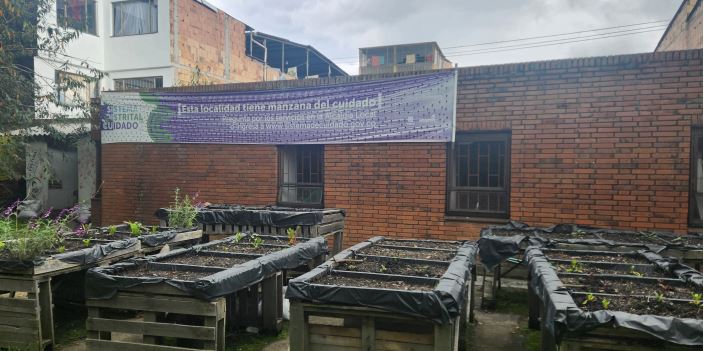
The exterior of one of the community hubs in Engativá-Pueblo, Bogotá
Unpaid care work: the invisible burden
Despite progress in women’s rights, household duties remain largely unchanged globally. Women continue to disproportionally shoulder the burden of unpaid care work - caring for children and elderly relatives and managing domestic tasks. This labour is essential for the wellbeing of families and communities, yet its value often goes unnoticed.
But, imagine if unpaid care was acknowledged as a cornerstone of public wellbeing and cities built systems to support carers. Bogotá, Columbia is doing just that. Its initiatives promote economic and social opportunities, improve wellbeing and return time to those dedicated to domestic roles.
Introducing Bogotá's 'Blocks of Care'
Bogotá’s care centres, known as manzanas del cuidado or ‘Blocks of Care’, use existing infrastructure and share programs across government agencies and other entities. These centres are cost-effective, flexible and responsive to local community needs. Since their launch in 2020, tens of thousands of women have visited the centres, learning new skills from digital literacy to starting small businesses - and even how to ride a bicycle.
Through education, respite and income generation activities, women carers expand their horizons, learn new skills and reclaim their time. These opportunities, which are 100% free, represent the only case I'm aware of globally where a policy has been designed around returning time and opportunity to those who have the most burden of care and domestic responsibility. It’s an exciting policy development and we're hoping to take best practices and share them with policy makers in other countries.
- Professor Piscopo
Professor Jennifer Piscopo, Director of the Gender Institute at Royal Holloway, University of London, travelled to Bogotá to investigate developments in care policy and understand how the initiative can be adapted and replicated in other contexts and countries. She visited six community centres, interviewed 29 staff members, and held focus groups with 25 women.
What she learned was that these centres are a lifeline for many community carers, empowering women through services like recreation, income opportunities and workshops on women’s rights. As one of the instructors explained: “This is how women learn they are citizens with rights, that 18 hours of work a day in the home is work.”
Each care block offers:
- One full-time coordinator
- A full-time lawyer and psychologist providing counselling and legal support
- At least one childcare specialist
- Instructors leading courses that focus on women’s rights and shared domestic responsibilities
- Visiting instructors for other courses and programs

Caregivers can leave children aged one to eleven while they participate in activities at the manzana

Empowering women and communities
Carers use the centres in different ways, but all agree they help them prioritise their own needs. Multiple women said that before the manzana, they did not take time for themselves. One participant said: “I did not think I also needed to care for myself and realised that doing so made it possible for me to care for others.”
Training courses run by Bogotá’s National Training Services and city councils, include entrepreneurship and small business development. At a small fair where graduates of the entrepreneurship course sold their homemade products, one woman said, “When we have to depend on our husbands for money, there are problems, but manzanas have given us economic autonomy.”
The benefits of these centres are huge, not just for the women attending, but for the whole community. They put women at the centre of the city’s transformation toward a more inclusive space.
Next steps
Professor Piscopo is joint head of the Care, Rights and Inclusion Project (CaRI) along with gender and humanitarian expert, Dr Kiran Stallone. They have co-authored a report that will launch publicly at an event including international organisations and guest speakers. In October 2025, Professor Piscopo also presented the results at a side-event at the 4th Ministerial Meeting of Feminist Foreign Policy in Paris.
To read a copy of the report click the button below:
Bogota 'Blocks of Care' ReportAbout the authors
Professor Jennifer M. Piscopo is Professor of Gender and Politics and Director of the Gender Institute, Royal Holloway, University of London
Dr Kiran Stallone is a Radcliffe Fellow, Harvard University, and Senior Researcher at Ladysmith Collective
Return to our Research in Focus page to uncover more exciting research happening at Royal Holloway, University of London
Research in focus