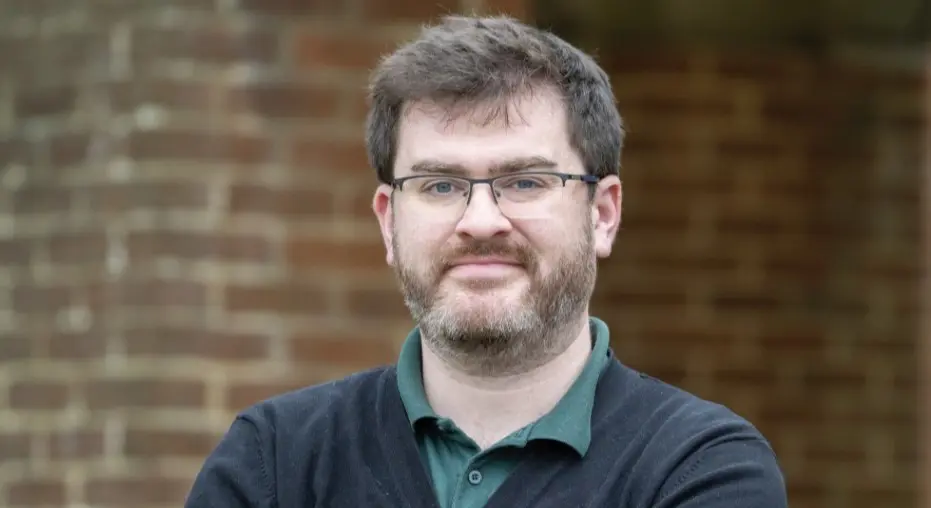
We have been delighted to welcome alumnus Dr Alex Sessa back to the University as Bedford College Project Archivist, a role funded by generous donations from Bedford College alumni during the 175th anniversary celebrations. We recently spoke to Alex about what attracted him to the role, the work he’s been doing to unlock and expand access to these remarkable collections, and his plans for the coming year.
What was it about the Bedford Project Archivist role that first caught your attention?
As a proud alumnus of Royal Holloway and Bedford New College, I was immediately interested in the role of Bedford College Project Archivist. Having completed history degrees, I am keen to develop collections focusing on social movements like women’s advancement in higher education. Bedford College has a vast archival collection, with materials ranging from women’s suffrage to the abolition of slavery, to refugee aid. Working with these collections has been a dream come true! Furthermore, I am particularly excited about further developing our oral history collection – a project I first began work on during my time as an MA student. For me, oral history provides people a unique opportunity to share their experiences. I am deeply passionate about making the past accessible and engaging, and I am proud to facilitate access to this rich collection.
How did you feel when you learned you’d been appointed to a role that is so closely linked to the College’s history and heritage?
Being appointed to the role has been a great honour. I felt excited about being offered the role and I feel privileged to be able to work with such a fascinating collection. It is a joy to be able to work with our students, researchers, volunteers, and the Bedford Society. On several occasions I have been contacted by researchers looking for information about their relatives who attended Bedford. I’ve noticed that many feel overwhelmed by the process. They want to know more about family connections but often don’t know where to start. During my short time with the archive, I have had several such queries. It is truly a rewarding experience to be able to provide this information for researchers. As I sift through files, I am struck by the fact that Bedford College had such a positive effect on so many people’s lives. In my view, these documents are not simply relics of the past: they reflect the lives of actual living human beings who sought an education during a time when girls and women were often excluded from higher education. Being able to share this information with researchers today – highlighting their grandmothers’ and great-grandmothers’ ambitions – is an incredible feeling. These documents reflect stories – I see my job as making those stories accessible to everyone!
Now that you’ve started in post, what has struck you most about the Bedford College Archive?
What strikes me about the Bedford College Archive is its vastness. We have material that spans all the way back to Bedford’s inception in 1849. The collection contains materials that contextualise the life of Elizabeth Jesser Reid, the American Civil War, the fight to abolish slavery, the struggle to secure women’s right to vote, and the challenges of studying during the World Wars. Furthermore, I am struck by the many achievements of women academics who were associated with Bedford College.
Have you come across any items or stories already that particularly surprised or excited you?
I have! Presently, I am undertaking research into Susan Stebbing. Stebbing was a philosopher and Lecturer at Bedford College, and the first woman to hold a Philosophy chair in the United Kingdom. During the 1930s, Stebbing agreed to supervise a Jewish male doctoral student from Germany, thus providing him refuge in Britain during the Holocaust period. An exception was made for him, given his exceptional record, thus allowing him to study at Bedford. A letter from Susan Stebbing to Ann Hook indicated that by 1940, Stebbing had aided multiple Jewish students from Nazi occupied Europe, thus saving their lives. These actions speak to the progressive ethos of Bedford College.
Is there anything you’ve found so far that you think the Bedford community will be especially interested in when it’s shared more widely?
My hope is that the Bedford community will be interested in the research we are conducting into humanitarian aid initiatives being conducted by Bedford staff and students. I think this work highlights the progressive spirit of Bedford College. Additionally, I plan to conduct further research into the women’s suffrage movement and the abolitionist movements.
What are you working on at the moment as you begin to explore and catalogue the material?
Currently, I am continuing my work into the study of academics at Bedford who assisted refugees. Additionally, I am interested in the experiences of faculty and students during both the First and Second World War. We are also planning to continue the oral history project, and I am very excited about this! I highly encourage any Bedford Alumni interested in speaking about their experiences to contact us.
How are you approaching the digitisation and transcription elements of the project, and what impact do you hope these will have for researchers and the wider community?
Currently, I am working with student volunteers who are assisting us with the transcription process. This process if particularly rewarding because it also allows me to share my love of history with aspiring archivists and historians. We are currently continuing a project to transcribe the personal papers of Elizabeth Jesser Reid (about 500 letters in total) and our oral history collection. The purpose of this project is to make these archival materials more readily accessible to researchers and the community. I am very confident that this work will result in our archival assets being readily accessible.
Are there particular themes or areas of the archive that you’re especially keen to bring to light through future blogs, social media features or talks?
Yes! As noted, I am quite eager to identify further materials focusing on the efforts of Bedford students and staff to assist refugees. I am also interested in contributions made during both the First and Second World War. Additionally, we have discussed the possibility of exploring women involved in the arts and sciences. Today, we tend to place these subjects apart. Yet, at Bedford College both the arts and sciences provided unique opportunities for women’s advancement in both academia and society. We are exploring different outreach initiatives, like a new blog (or ‘Digital Exhibition Space’, as I like to call it).
What opportunities do you see for engaging students, alumni and the public with the Bedford College archives?
We currently have many opportunities coming up to undertake volunteer opportunities. Additionally, we are hoping to arrange public talks in the near future. Furthermore, I encourage the alumni community to get in touch if they are interested in participating in the oral history project.
What excites you most about what this project can achieve over the next year?
Over the next year, I am confident that we will be able to produce original digital content using Bedford College’s archival assets. I look forward to continuing the oral history project – interviewing new people and transcribing our existing oral history projects – and enhancing access to the Elizabeth Jesser Reid papers through further transcription work. We already have volunteers coming in to look at these various materials and I hope to collaborate closely with the MA Public History module. This will be a fantastic opportunity for students undertake research for their final projects.
What does it mean to you personally to help preserve and promote this part of the College’s history?
For me, it is an honour to help preserve and promote Bedford College’s history. Bedford College’s place in history – being the first higher education institution for women in the U.K. – should never be forgotten. I feel truly humbled that I have been tasked with making sure this history is preserved, promoted and made accessible to everyone. I love when students come into the archive (often knowing very little about the history of Royal Holloway and Bedford College) and being able to point them to documents that contextualise this rich history. It’s wonderful to see the fascination on their faces when they’ve discovered something new. For me, history is not about the past. History is something that each of us lives and experiences. As members of the Royal Holloway and Bedford New College community, this is our history. Being able to promote this history is deeply rewarding and I am very grateful to be a part of this process!