Dr Sapna Mishra
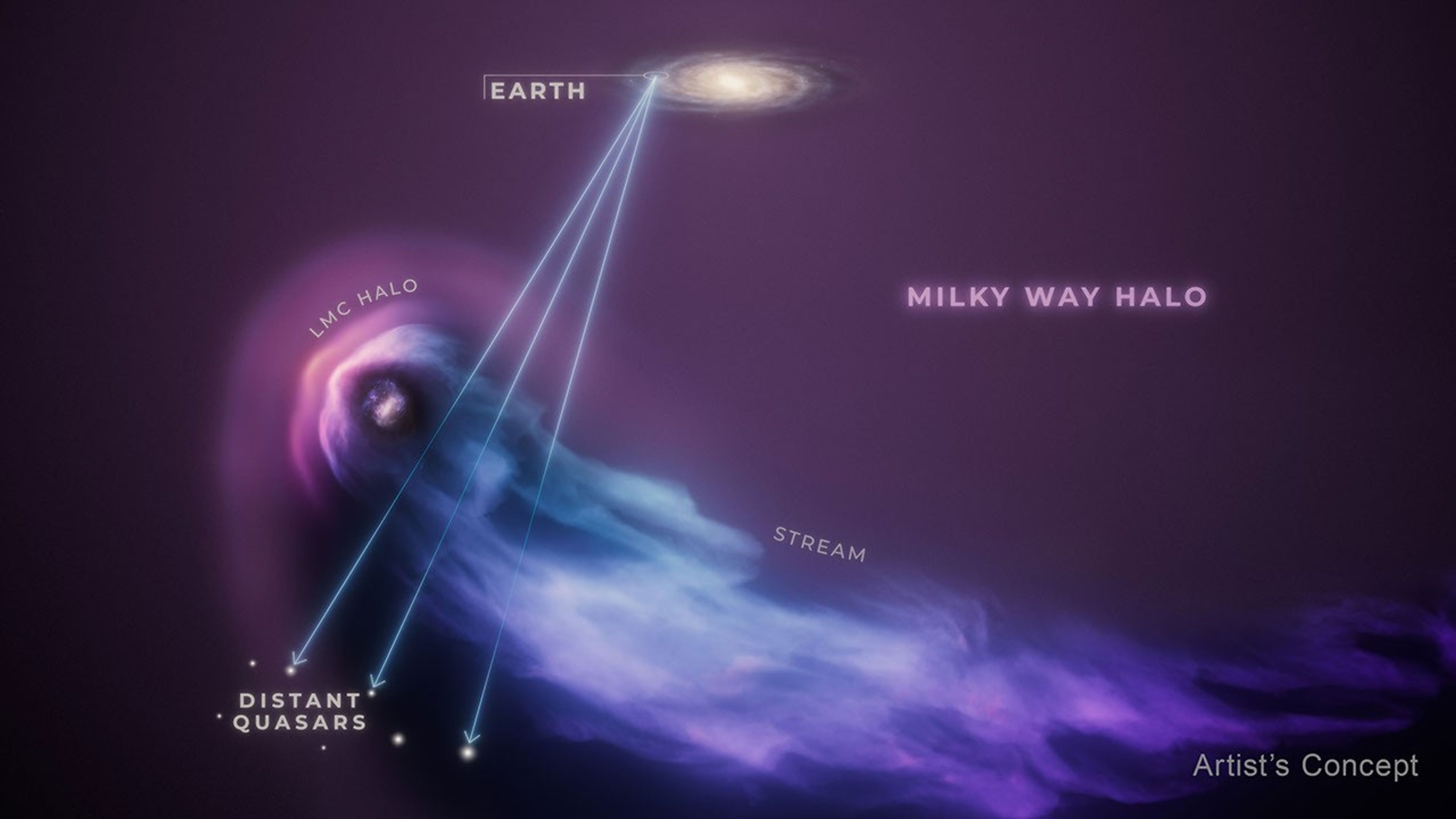
Satellite galaxies are not mere celestial companions—they play an active role in the ecosystem of galaxy evolution. Their interactions with massive hosts like the Milky Way (MW), through processes such as ram-pressure and tidal stripping, can significantly affect star formation and growth of both the satellites and their hosts. The circumgalactic medium (CGM) of the satellites, despite its pivotal role as both a gas reservoir and a shielding interface, remains poorly explored in the satellite systems. The Large Magellanic Cloud (LMC) is the only satellite with a well-characterized CGM to date. We recently mapped the LMC’s CGM, using 28 AGN sightlines observed with HST/COS within 35 kpc. Our UV absorption-line ((O I, Fe II, Si II, Al II, S II, Ni II, and Si III)) measurements reveal a two-component structure: an extremely truncated inner halo extending to 17 kpc, and a more extended, stripped region aligned with the Magellanic Stream. These results are consistent with simulations predicting ram-pressure stripping by the MW’s hot corona and provide a rare observational glimpse into the complex dynamics of a satellite CGM. However, key questions remain: How typical is the MW–LMC system in the broader context of galaxy interactions? Can all the LMC-like satellites retain their cold gas despite intense environmental effects? Answering these questions calls for direct observations of MW-LMC analogs elsewhere in the Local Group. This presentation will highlight the critical role of UV observations in the evolution of the satellite CGMs and discuss how our LMC results offer new insights into feedback, environment, and galaxy evolution in low-mass galaxies.
The NASA press release on this work and a schematic image describing the MW-LMC interaction can be found here.