Theoretical physicists unveil the frequency structure of the superconducting correlations.
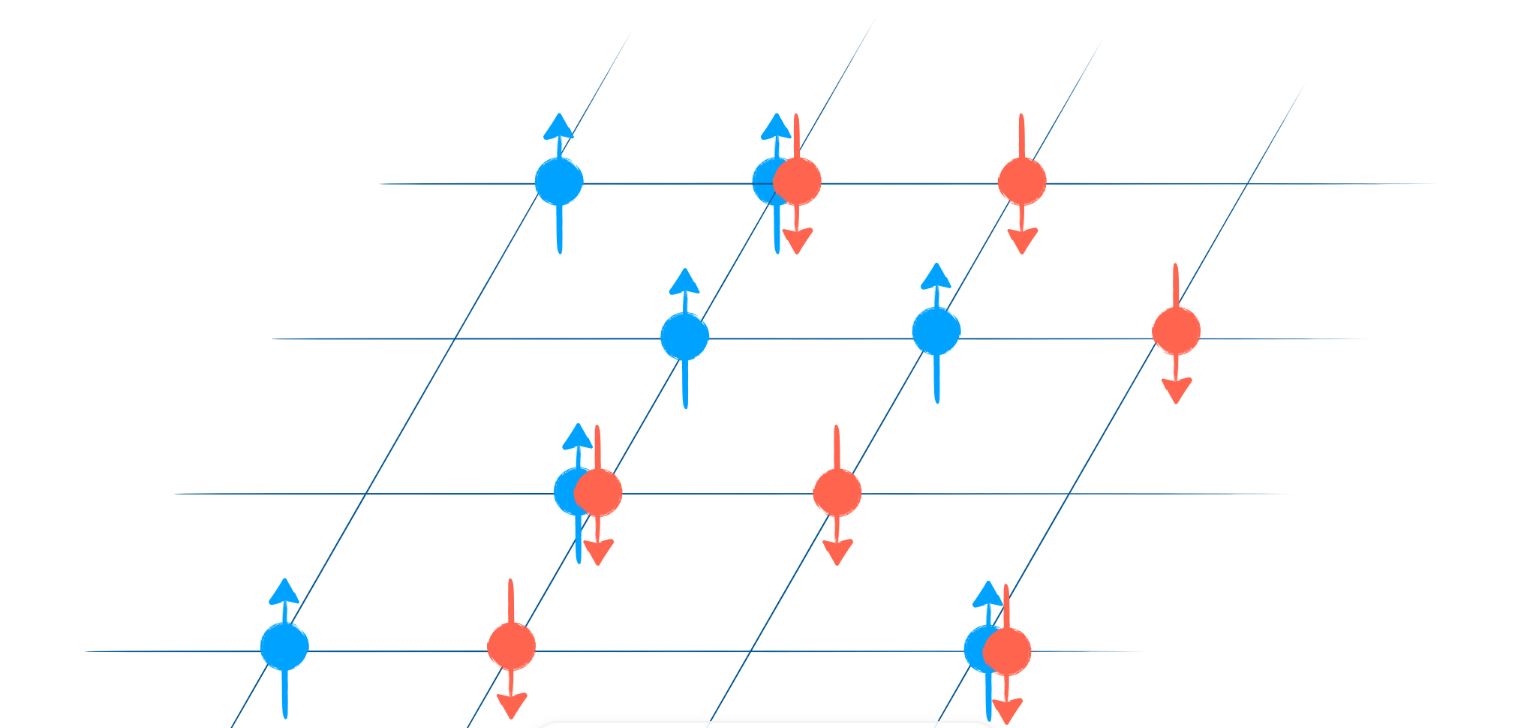
Sketch of the two-dimensional Hubbard model.
Superconductivity is a startling quantum phenomenon in which electrons pair up to flow without resistance. Cuprates are high-temperature superconducting materials with great potential for advanced quantum technologies. Yet, the underlying mechanism driving their superconducting electron pairing remains an open question.
Now, a team of theoretical physicists at Royal Holloway (master’s student Eleanor O’Callaghan, Dr. Caitlin Walsh, and Dr. Giovanni Sordi), at Université de Sherbrooke (Dr. Patrick Sémon and Prof. André-Marie Tremblay), and at Université du Québec à Trois-Rivières (Dr. Maxime Charlebois) have used modelling calculations to uncover the characteristic frequency scales that lead to superconducting pairing and their relative contribution to pairing.
Using the prototypical model of strongly correlated electron systems and state-of-the-art numerical simulations on high-performance supercomputers, the team has shown that pairing comes from low-frequency short-range spin fluctuations only.
At high frequencies, the effect of the onsite Coulomb repulsion is eliminated by the d-wave paring. By contrast, at small frequencies, the same onsite Coulomb repulsion dynamically generates the super exchange interaction which favours antiparallel spins on neighbouring sites, and thus their effective attraction. It is this emergent low-frequency interaction that leads to pair-forming processes and provide the net contribution to superconducting pairing.
Link to Article:
G. Sordi, E. M. O’Callaghan, C. Walsh, M. Charlebois, P. Sémon, and A.-M. S. Tremblay, Dynamics of Superconducting Pairs in the Two-Dimensional Hubbard Model, Phys. Rev. Lett. 136, 256503 (2026)