Professor Daniela Berghahn
The book Head-On, which appeared in the prestigious BFI Film Classics series, has evolved from Daniela Berghahn’s AHRC-funded projects on migrant and diasporic cinema in contemporary European cinema and diasporic family films. It examines Fatih Akin’s Gegen die Wand (Head-On). After winning the Golden Bear at the Berlin International Film Festival in 2004, Akin’s unconventional love story was hailed as a turning point for German cinema as well as a victory for Turkish cinema.
The book provides a detailed account of the film’s artistic inspirations, its production history and the debates that surrounded it in the Turkish and German press. Arguing that much of the media and scholarly discourse on Turkish German identity politics detracted from Akin’s remarkable artistic achievement, Berghahn situates Head-On in the critical contexts of global art cinema and transnational melodrama. This approach excavates new layers of meaning and offers highly original insights into Akin’s landmark film and its hybrid aesthetics that are as much indebted to German auteur Rainer Werner Fassbinder as to Turkish Arabesk cinema.


Professor Mandy Merck
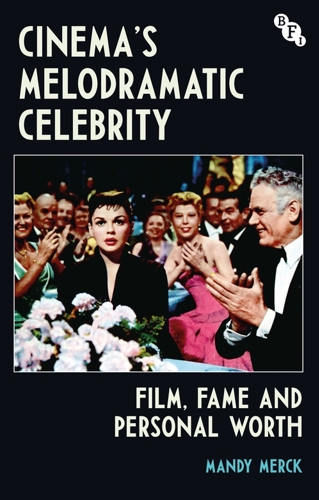
Challenging the study of both celebrity and the cinema, in Cinema’s Melodramatic Celebrity: Film, Fame and Personal Worth (BFI Bloomsbury, 2020), Mandy Merck argues that modern fame and film melodrama are part of the same worldview, one that cannot resolve the relation of personal worth to social esteem. Tracing the history of this conundrum back to the philosophy of the seventeenth and eighteenth century, from Hobbes to Rousseau, and the theatre of the eighteenth, from Rousseau to Pixérécourt, she demonstrates its convergence in stage melodrama and its intensification in the Hollywood star system. Are today’s celebrities worth our attention? In that demand for judgement and the hope for its visual guidance, the melodramatic imagination survives – permeating not only fiction film, but documentary, the artist’s film, and our self-exhibition on social media.
Examining a range of classical and contemporary films from Charlie Chaplin's City Lights (1931) to Laura Poitras’s Citizenfour (2014), the endless remakes of A Star Is Born, the compulsory exhibitionism of political celebrity and the unmasking of whistle-blowers, Merck illustrates the ways in which the cinema constantly restages the moral evaluation of prominent individuals, whether they are actors, artists, politicians or activists.
‘An exhilarating read, in its hugely impressive range of references, the unexpected connections it makes, and the wide range of films it considers. This is a major study which advances the theorization of melodrama, celebrity culture, and the relationship between the two.’ – Sue Thornham, University of Sussex, UK
Professor Chris Townsend and Dr Rhys Davies
Chris Townsend and Rhys Davies collaborate on the archaeology of modernism’s imaginary media. Inspired by the Dutch theorist Eric Kluitenberg, they take the never-realised or only partly-achieved media projects of early 20th century modernism and explore how these imaginary artworks might have looked, and performed, had they been completed, using only the technologies available to the original artists.
Their latest project, working with Alex Trott of Oxford Brookes, has been in collaboration with the Tate In Focus. Using the surviving canvas of the British painter Duncan Grant’s Abstract Kinetic Collage Painting, with Sound (1914), along with surviving drawings for winding apparatus, and statements by the artist, Townsend and Davies have come up with a radical re-appraisal of this extraordinary artwork. Their analysis and the accompanying construction of a possible, finished device, challenges existing notions of the work as in some way cinematic and places it instead in a utopian domestic context, as something far closer to television in its anticipated mode of consumption, whilst remaining a unique and singular medium – a painting that moves, to the accompaniment of recorded music.

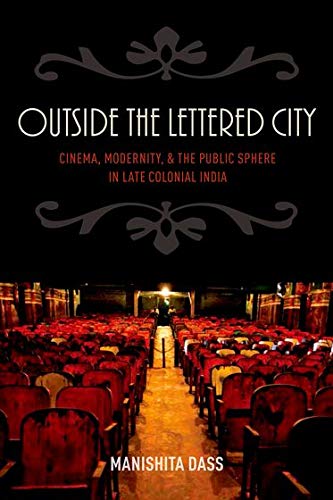
Dr. Manishita Dass
Outside the Lettered City by Manishita Dass traces how middle-class Indians responded to the rise of the cinema as a popular form of mass entertainment in early 20th century India, focusing on their preoccupation with the mass public made visible by the cinema and with the cinema's role as a public sphere and a mass medium of modernity. It draws on archival research to uncover aspirations and anxieties about the new medium, which opened up tantalizing possibilities for nationalist mobilization on the one hand, and troubling challenges to the cultural authority of Indian elites on the other. Using case-studies drawn from the film cultures of Bombay and Kolkata, it demonstrates how discourses about the cinematic public dovetailed into discourses about a national public, giving rise to considerable excitement about cinema's potential to democratize the public sphere beyond the limits of print-literate culture, as well as to deepening anxieties about cultural degeneration. The case-studies also reveal that early twentieth century discourses about the cinema contain traces of a formative tension in Indian public culture, between visions of a deliberative public and spectres of the unruly masses.