Another weekly newsletter that overflows with exciting content.
I have been inundated with contributions from students and staff- I am grateful to everyone for embracing this initiative with such enthusiasm, but please keep sending me material for the newsletter.
In this week’s issue:
- “Dig to Digital” in a teaching lab
- Maisie and Eleanor’s filming project
- Updates from the Classics Society + advance notice of Christmas Social
- Dr Lowe judges the Hellenic Prize
“Dig to Digital” in a teaching lab
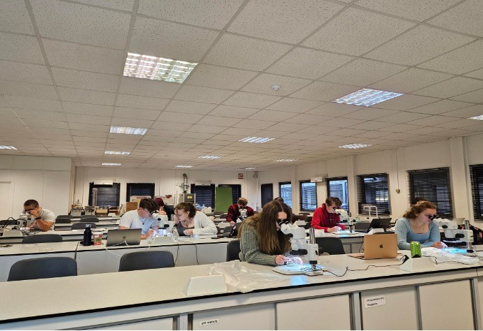
Dr Erica Rowan, Professor Jari Pakkanen and Dr Zena Kamash, co-teach the second-year module CL2194 Dig to Digital. Dr Rowan writes about a special session: “The module always includes a lot of practical components. Last week we took things one step further and the students ventured out of their usual classroom and into the Munro Fox teaching lab for an archaeobotany practical. Students took a look at some ancient and modern seeds down the microscopes, and practiced separating the seeds from the charcoal in samples from the Roman city of Utica in Tunisia.”
Maisie and Eleanor’s summer filming project
This summer Eleanor Atterton and Maisie-May Gilchrist helped with the production of a Classics-themed documentary and Maisie shares some of their experiences:
'Eleanor and I worked on a Classics documentary/retelling of the Odyssey over the summer and the first episode was released on Sunday! We were production assistants who were part of a team that flew to Corfu and took part in two amazing weeks filming on gorgeous beaches, in beautiful little towns and Airbnbs. We helped with the filming by holding cameras and lights, standing in for shots to check angles, running around setting up the sets, and being generally useful to everyone. We also had lots of roles behind the filming including driving everyone around, cooking for the crew as well as providing our Classical knowledge when needed (and Eleanor is now a pro at slating each shot). It was very intense with 5am starts in order to fight the heat and shoot for as long as possible, but it was an amazing experience despite the tiredness. The project is called The Odyssey in a Day and splits the story up into three parts - breakfast, lunch and dinner - in order to make Classics interesting and engaging for people (especially for non-Classicists). It was all created and organised by a Classicist friend, Cosi, who wanted to create something to make Classics accessible and fun!
Updates from the Classics Society
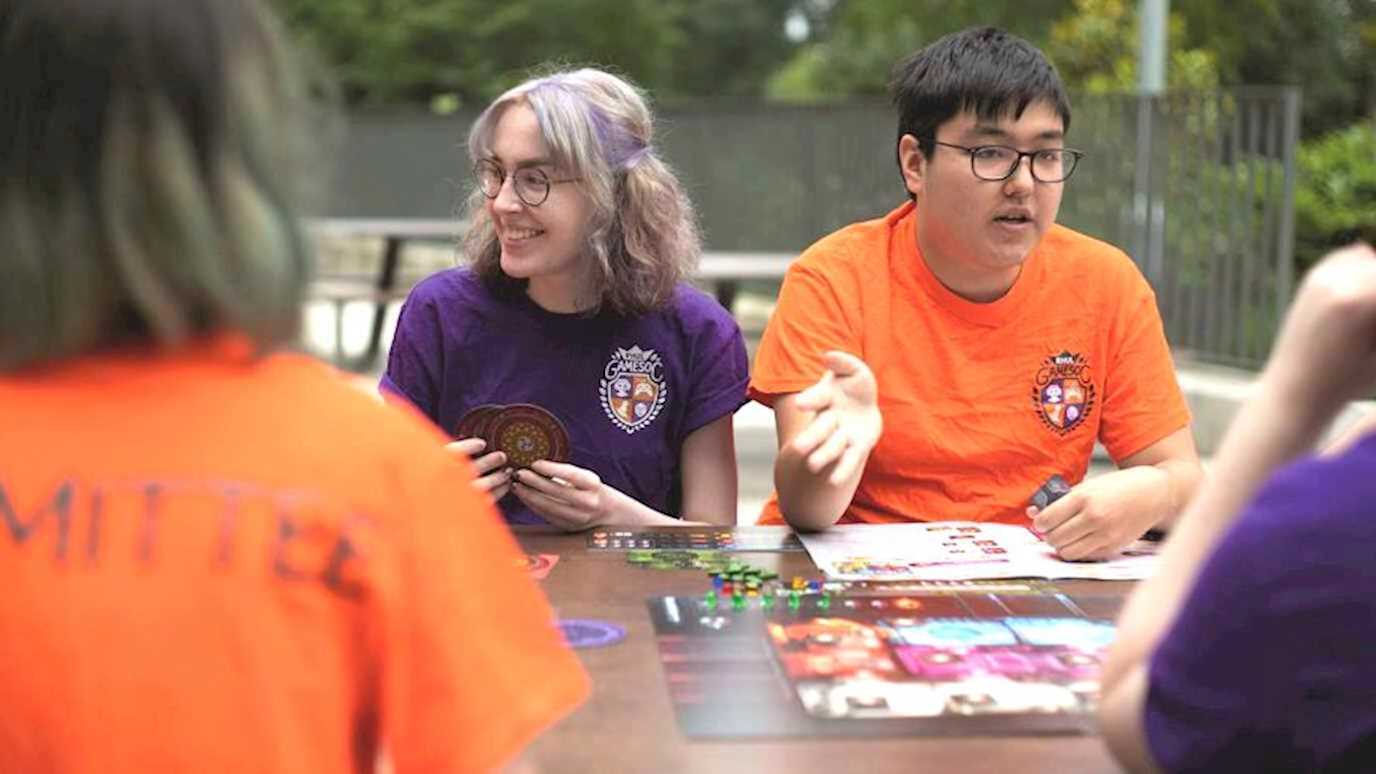
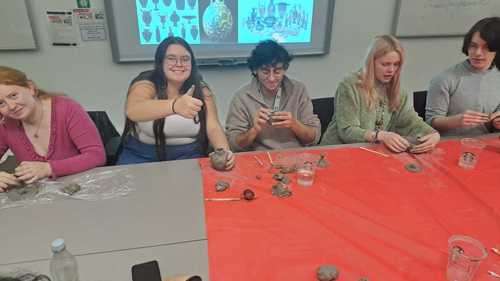
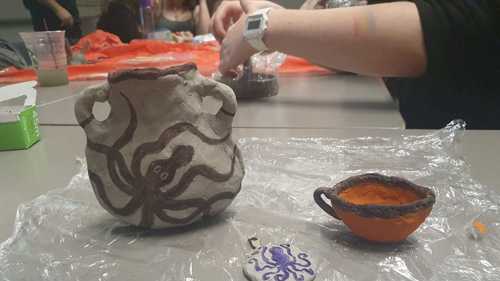
The Classics Society have recently held a pottery session that also featured decorating the pots with Greek motifs.
Two further notices: 1) The Classics society are planning a trip to Bath to see the Roman Baths. Please find further details on the Classics Society SU page or on Instagram. 2) The Society and the Classics Department’s members of staff are co-organising a Christmas social on the 4th of December at/from 16:00. Further details will follow but please put the date/time in your calendars. It will be a wonderful opportunity for our Classics Community to come together at the end of the term.
Dr Lowe Chairs the Hellenic Prize Committee
Dr Lowe has been on the adjudicating committee of the prestigious Hellenic Prize for a long time and has been its Chair for the past two years. He put together a few words on the experience of selecting a prize-winning entry among 100+ submissions.
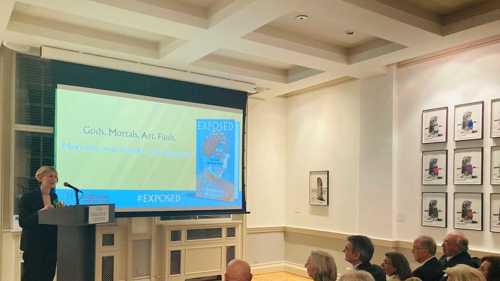
“Last Friday, 10 November, the London Hellenic Prize held its annual award ceremony in a packed event at the Hellenic Centre in Marylebone, its spiritual home since the Prize's inception in 1997. For the last 25 years I've been on the panel of judges for the LHP, which is the younger and hipper of the two big annual book prizes in Classics, and I'm currently a couple of years into a sentence as Chair. Our winner this year was Caroline Vout's Exposed: The Greek and Roman Body, an amazing tour of ways in which the human body is represented, thought about, and inhabited in antiquity, which was published by the comfortably-funded Wellcome Institute and gorgeously produced as a high-quality hardback crafted in Italy with colour illustrations throughout - a kind of coffee-table book in compact form. I spoke about this year's other shortlistees and Oliver Taplin about Exposed, before the Greek Ambassador made a nicely-judged speech on Anglo-Hellenic relations and formally presented the prize, and Carrie killed it with an illustrated acceptance talk teasing some of the extraordinary images and stories from her book.
The world of book prizes is a curious one. Judges do a colossal amount of reading – last year my own pile alone was somewhere north of sixty books – only to find themselves then having to decide on an overall winner by somehow weighing academic titles against popular non-fiction, literary and bestselling novels, children's books, volumes of new and translated poetry, art books, even graphic novels. The LHP’s particular remit is for exceptional books that present Greek culture, history, and art ancient or modern to the non-specialist reader in English: books doing something intellectually or artistically outstanding, but which you could still give to your aunt or take to the beach. Though academic authors are well represented among our finalists (three out of six this year), we see a lot of wonderful scholarly books too nerdy and specialised to stand a chance of making the shortlist, along with a steady annual crop of usual suspects like philosophical self-help volumes and would-be next Madeleine Millers; while historic anniversaries draw a surge of tie-ins, last year for the bicentenary of the Greek revolution and this year marking the centenary of the brutal ethnic cleansing of Smyrna in 1922, a historic atrocity etched deep in Greek memory.
Our finalists this year included two poetry collections, a WWII biography, a novel about Smyrna, and a book on mountains in ancient culture. Any of these could have won, but it became clear near the finish line that Exposed was the volume to beat, and the standing-room-only audience – including me, after a celebrity guest cheekily took my seat during my speech – was testament to the book’s many fans from inside the academic world and far beyond. One veteran of past ceremonies said it was our best ever, and I wouldn't disagree. Particular thanks are due to our amazing postgrad administrator Francesca Kaminski-Jones - and to my 5.00 Myth seminar group for letting me get away early, when we found at short notice that I was needed to sneak in ahead of time to sign a mounted certificate (a classy addition this year) and wrestle it into a frame without any of the guests seeing. Such is the backstage life behind book-prize showbiz. Next time you see one of those stickers on a book cover, you’ll know that half-a-dozen academics read a hundred-odd other books and argued for hours to put it there.”
A few contributions which came in on time for inclusion in this week’s newsletter will have to wait until next week, I am afraid. Thank you to everyone for helping strengthen the sense of belonging to the Classics@RHUL community!
I hope you all have a wonderful weekend!
Christos