A team from the Department of Biological Sciences at Royal Holloway, University of London is helping to address the challenge of antimicrobial resistance (AMR) in agrifood systems, a new £3 million project as UK government and UKRI invest £54m to tackle biosecurity threats.
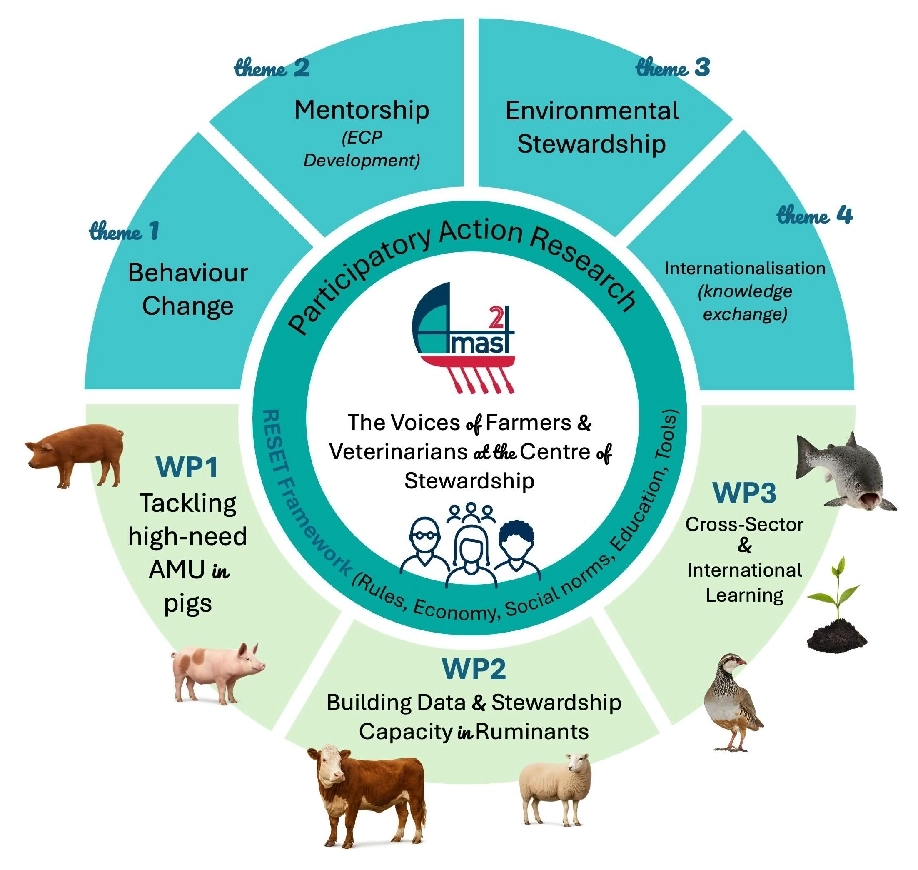
AMAST Phase Two: Cultivating Mindsets and Practices for Antimicrobial Stewardship in Agrifood Systems
AMAST-2, a UKRI funded project with a budget of £3million, brings together researchers from 13 organisations alongside veterinary, farming, industry and government partners and concentrate on three connected areas:
Pigs: working with farmers, veterinarians and advisers on farms facing sustained disease and antimicrobial-use challenges, using swine dysentery as a model to connect better diagnostics, biosecurity, farm management and decision-making.
Ruminants: putting the UK Ruminant Antibiotic Stewardship Roadmap into practice. Led by the Royal Veterinary College with RCVS Knowledge, Royal Holloway University of London and the Royal Agricultural University, this work will co-design trusted ways to collect and use antimicrobial-use data so farmers and veterinarians can understand their own use, benchmark progress and make informed stewardship decisions.
Across agrifood: identifying approaches that work across livestock, aquaculture, gamebirds and crops, and bringing international experience into UK stewardship.
Royal Holloway University of London is part of the management team behind AMAST, bringing its expertise in Epidemiology and One Health for combating AMR. Our staff has a significant track record on research for antimicrobial use and AMR in agrifood systems worldwide.
The RHUL team will co-lead WP2: Ruminants – Building Stewardship Capacity and Data Systems with the following objectives:
Strengthen understanding of stewardship drivers and responsibilities across the supply chain by exploring how cultural, economic, and professional dynamics shape prescribing behaviour, trust, and climate-related disease pressures, and mapping stewardship responsibilities to identify leverage points for improvement.
Co-design practical data collection models and decision tools by developing, piloting, and evaluating alternative models for AMU data capture and feedback, ensuring systems are functional, trusted, and aligned with existing platforms such as Medicine Hub and the Welsh WLBP calculator.
Review and co-evaluate Plan–Prevent–Protect alternatives by assessing the feasibility, cost–benefit, and barriers to uptake of protective strategies including vaccines, diagnostics, nutritional interventions, biosecurity practices, and waste management approaches.
Pilot interventions and support behaviour change by trialling small-scale stewardship interventions, establishing social learning groups, and embedding AMU reflection feedback loops to enable practice-level behaviour change and visible progress monitoring.
Synthesize learning and deliver sector-endorsed roadmap updates by integrating pilot findings and environmental stewardship practices into an updated UK Ruminant Antibiotic Stewardship Roadmap, endorsed by RUMA and key veterinary and producer organisations.
Dr. Mahmoud Eltholth, Associate Professor of Global Health in the Department of Biological Sciences, AMAST co-lead, said: “AMR is a global challenge that cannot be addressed by a single discipline alone. Multidisciplinary and transdisciplinary research, guided by systems thinking and participatory engagement with stakeholders, is essential for developing sustainable solutions.”
Prof. Isabel Smallegange, Head of the Department of Biological Sciences, said: “We are proud to contribute to this project, which connects research with the practical challenges facing farmers and veterinarians. Working closely with those who will use the findings will help the team develop approaches that are workable in everyday practice and support responsible antimicrobial use alongside animal health and welfare.”
Over the next five years, the AMAST-2 project will integrate field research across multiple disciplines and livestock production systems to evaluate the effectiveness, feasibility, and sustainability of interventions aimed at reducing antimicrobial use and mitigating AMR. By adopting a One Health, systems-thinking approach, the project will assess the economic, ecological, and social impacts of these interventions while generating evidence to support sustainable livestock production, improved animal health and welfare, and responsible antimicrobial stewardship.
The project’s findings will contribute directly to the UK National Action Plan on Antimicrobial Resistance NAP-AMR by accelerating practical progress on antimicrobial stewardship.