Our 'Research Spotlight' series highlights some of the exciting audiovisual research happening at Royal Holloway. Here, we get to know a little about Professor Hannah Thompson's work on audio description in museum and gallery settings.
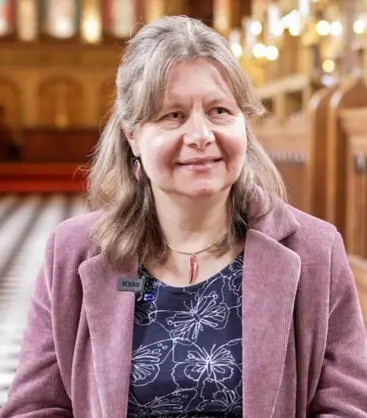
Please briefly introduce yourself and your role at Royal Holloway.
I am Professor of French and Critical Disability Studies in the department of languages, literatures and cultures.
What’s your area of research? What led you to this field of work, and why do you continue to find it interesting?
I started out as a nineteenth-century French literature specialist. I have increasingly become interested in how disability has been understood in society, literature and the media. I describe myself as ‘partially blind’ and I have developed the theory of ‘blindness gain’ to explain how a better appreciation of blindness can benefit non-blind people.
Please tell us about some of your recent research related to audio-visuality (in the broadest sense).
At the moment I am working on the artistic potential of audio description in museum and gallery settings. Audio description is an excellent example of ‘blindness gain’ – it was originally developed as an access tool for blind people but is now beginning to be recognised by everyone as a creative genre in its own right. I am exploring how audio description works as a kind of intermodal translation that can enhance the museum experience for all audiences.
What were/are the challenges of this research?
Traditional audio description can convey visual information, but it cannot create an aesthetically engaging or emotionally captivating experience. I am using examples from French literary and artistic descriptions of paintings to try and create a mode of audio description that better matches the experience of standing in front of the work of art in a gallery.
How do you imagine this research developing in the future?
I’d love to explore how technical developments such as binaural audio might enhance the experience still further.
What do you enjoy most about your work?
I love being involved in co-creating audio description of artworks. Because everyone uses language differently and everyone notices different things about an artwork, describing as a group is always surprising, memorable and moving.
And what do you enjoy beyond your academic life?
I love reading contemporary fiction and travelling by train (often at the same time). I also go ice-skating at my local rink twice a week.