Our 'Research Spotlight' series highlights some of the exciting audiovisual research happening at Royal Holloway. Here, we get to know a little about Dr Simone Gigliotti's work on histories and geographies of the Holocaust.
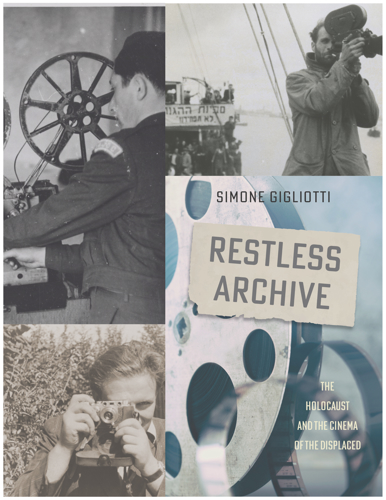
Simone Gigliotti. Restless Archive: The Holocaust and the Cinema of the Displaced.
Please briefly introduce yourself and your role at Royal Holloway.
I am based in the Department of History, where I am Reader in Holocaust Studies, and contribute to the mission of the Holocaust Research Institute, of which I am Deputy Director. I also represent Royal Holloway in the UK national node of the European Holocaust Research Infrastructure known as EHRI-UK.
What’s your area of research? What led you to this field of work, and why do you continue to find it interesting?
There are several areas of research, but most consistently over my career, I have been preoccupied with understanding the multiple histories and geographies of the Holocaust, in their European origins and global ramifications through migration, displacement and postwar memory networks. Fundamentally, I place the perspectives of victims and survivors at the core of almost everything I do.
Please tell us about some of your recent research related to audio-visuality (in the broadest sense).
I started working in the field of Holocaust testimony and its technologies many years ago and have charted how evolving recording and regenerative technologies have shaped the tellability of traumatic experiences (videotape, digital platforms, AI). My most recent research on this topic was Restless Archive: The Holocaust and the Cinema of the Displaced (2023), a fully online digital monograph and platform which explored how remnant non-fiction visual material (mostly visual and with a smattering of recorded audio) could be interpreted and mapped as an aggregated and interactive cartography of displacement of Jewish refugees and survivors from 1933 to 1949.
What were/are the challenges of this research?
The project took many years to develop, control (in terms of its historical archive), and write. The main challenges related to scaling of limits and narrative – what were the borders and geography of historical experience and filmmaking that were tracked and regenerated via digital platforms and in the monograph?
How do you imagine this research developing in the future?
Certain chapters of that book could easily develop into spin-off studies or studies of archival visual assembly, especially in relation to home movies where sound is inferred but not heard. Indeed, do audiences need to hear sound to understand the actions and interactions? I would like to produce some micro-shorts and curations of existing archival content about homing instincts in displaced societies and the sonic absence or imagined sound worlds.
What other exciting projects (current or planned) would you like to share with us?
Currently I am in discovery and collection mode for a project on mobile and underground cinemas, cultural programming, and the re-use of former heritage sites in postwar Europe (1945-1955). I am undecided if this project will be a book and/or documentary series.
What do you enjoy most about your work?
I relish the thrill of discovery, and being able to embroider different archives and traces of historical events into something that is meaningful to me, and hopefully others, too.
And what do you enjoy beyond your academic life?
I dabble in the creative arts and digital map making.