Sparking the future of Physics
Many of our Physics students get to spend time at CERN, the European Laboratory for Particle Physics on the French/Swiss border near Geneva, home to the world's largest science experiment. Accompanied by Royal Holloway academics with close research links at CERN, this highly anticipated trip is an exciting opportunity to experience the cutting-edge of physics.
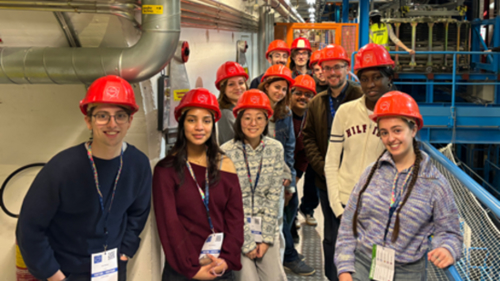
Studying Physics at Royal Holloway means you'll join a community at the forefront of discovery. Our academics involvement in international research directly informs your learning, connecting what you study with real-world science. From state-of-the-art facilities on our campus to visits at leading research facilities and the annual CERN trip, you’ll gain not just knowledge – but experience, confidence, and a launchpad for your future in physics and beyond.
As founding members of the ATLAS experiment at the Large Hadron Collider (LHC), we have a long standing involvement in research discoveries at CERN and in the ongoing, detailed study of physical properties there. During your studies, undergraduate and postgraduate students can work on CERN-linked projects and may even secure a summer internship. Some of our PhD students have also spent extended periods of time working directly at CERN.
On our CERN fieldwork trip with second-year undergraduates every spring, you'll explore the facility and view fascinating physics processes first hand.
What to expect on your visit to CERN
From the moment you board the early morning flight to Geneva, the excitement starts building. Arriving at CERN, you’ll don a hard hat and venture underground, heading to see the location of groundbreaking discoveries, like the Higgs boson, and witness the practical application of theories and ideas you are learning about on your course.
Accompanied by an academic who is involved in major CERN experiments, you’ll be led on an insider’s tour of the facility to see how research from Royal Holloway has contributed to past projects and find out more about where future investigations might lead.
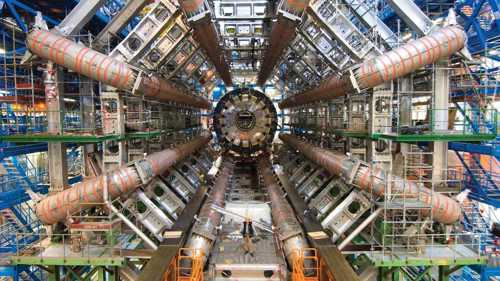
Depending on what is actively happening you’ll likely get the chance to see the ATLAS particle detector up close and will also be shown other interesting parts of the Large Hadron Collider. You’ll be able to meet and talk with some of the global community of scientists, researchers and technicians currently working at CERN and start to build your future network.
On your return to the UK when you reflect on everything you’ve experienced, take a moment to be inspired and imagine where your own Physics journey might take you.
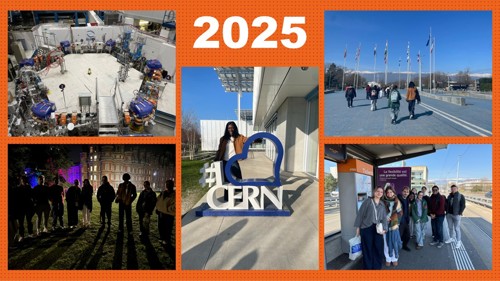
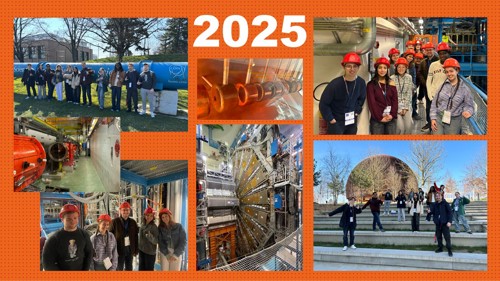
A few highlights from previous trips:
- 2025: Included an exciting stop at both the ATLAS detector and CERN’s Linear accelerator (Linac2).
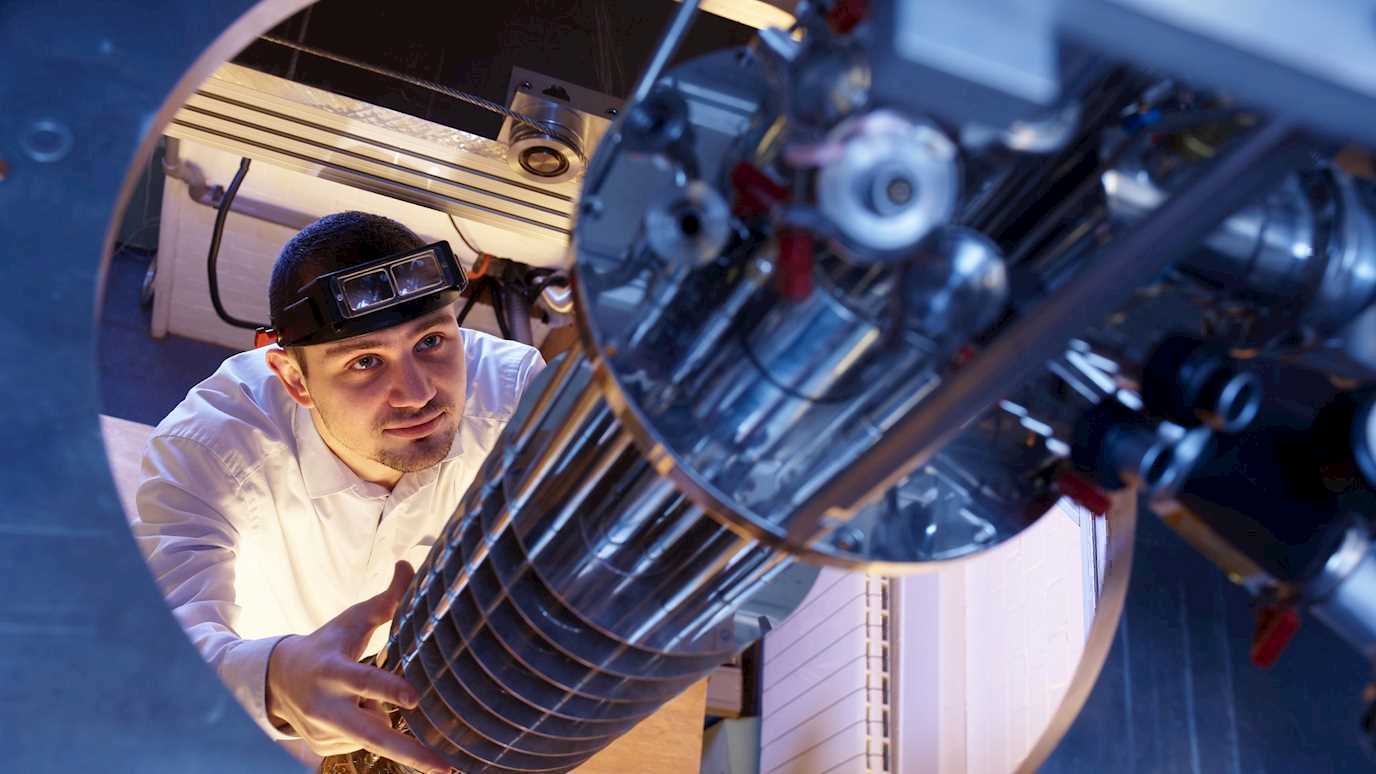
- 2024: It was thrilling to see the electro-optical beam position monitor that was built at Royal Holloway being tested at CERN as part of the High- Luminosity LHC project during this visit. It was set to test various new experiments that Physicists had been eagerly awaiting.
- 2020: The group got real insight into the workings of CERN as they were shown around by Royal Holloway student, Helena, who was working there during their visit.
- 2018: A snowy start from Royal Holloway beat a snowless Switzerland on this trip!
- 2017: The group were excited when they got to see the ATLAS cavern and Linac4.
- 2014: The trip included a visit to ATLAS detector, the ATLAS Cleanroom: Insertable B-Layer, and a view of a bubble chamber, before ‘The Physics Gang’ posed for their obligatory class photo!
What is CERN?
CERN is home to an intergovernmental organisation that conducts research into particle physics, investigating the fundamental nature of matter. Set up in 1954, CERN has pushed the boundaries of human knowledge, deepening our understanding beyond the nucleus.
From its location on the French/Swiss border, CERN unites an international team of scientists, researchers, engineers and technicians carrying out research and working on projects investigating the most important questions for physics today. Alongside the scientific breakthroughs, the tools and discoveries made at CERN have also had an impact on everyday life, driving advancements in technology that have influenced everything from computing to healthcare, the environment to aerospace - and even the world-wide-web, which originated in CERN.
What is the LHC?
CERN is also the site of the Large Hadron Collider, or LHC – the world’s largest and most powerful particle accelerator. Buried deep underground in circular tunnels 27-kilometres long, the LHC sends beams of particles hurtling towards each other at almost the speed of light. The beams are designed to collide at four locations along the ring – the particle detectors ATLAS, CMS, ALICE and LHCb. It's at these collision spots that Physicists aim to ‘smash’ particles together so they can study how the particles behave, uncovering data about the fundamental building blocks of the universe and the forces that govern it.
Royal Holloway's links with CERN
Academics in our Department of Physics were among the founding members of the ATLAS experiment which, alongside the CMS experiment, built and ran one of the detectors that discovered the Higgs Boson at CERN in 2012. Since then, a large contingent of our scientists and researchers have continued to play key roles in studying its properties and continued to contribute towards the ongoing upgrades and developments of the LHC.
Royal Holloway scientists are also among the group of global researchers awarded the 2025 Breakthrough Prize in Fundamental Physics. The prize was awarded to the four sister experiments – ATLAS, ALICE, CMS and LHCb - at CERN. You can read more about this news here.