Dr Nikhil Sarin
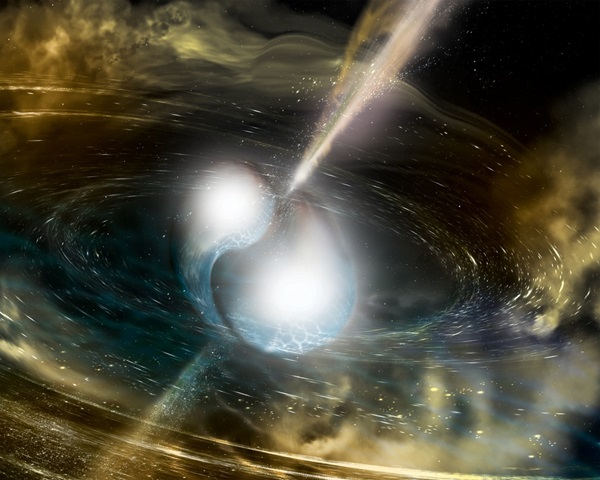
A neutron star binary merges somewhere in the Universe every 100-1000 seconds, creating violent explosions potentially observable in gravitational waves and across the electromagnetic spectrum. The transformative coincident gravitational wave and electromagnetic observations of the binary neutron star merger GW170817 gave invaluable insights into these cataclysmic collisions and fundamental astrophysics. However, despite our high expectations, we have failed to see any other event like it. In this talk, I will highlight what we can learn from other observations of mergers seen directly in gravitational waves, as a binary in our Galaxy, or indirectly as a gamma-ray burst and/or kilonova. I will also discuss the diversity in electromagnetic and gravitational-wave emission we can expect for future mergers and show how such observations can shed light on key questions in relativistic astrophysics, chemical enrichment of the Universe, and the behaviour of nuclear matter.