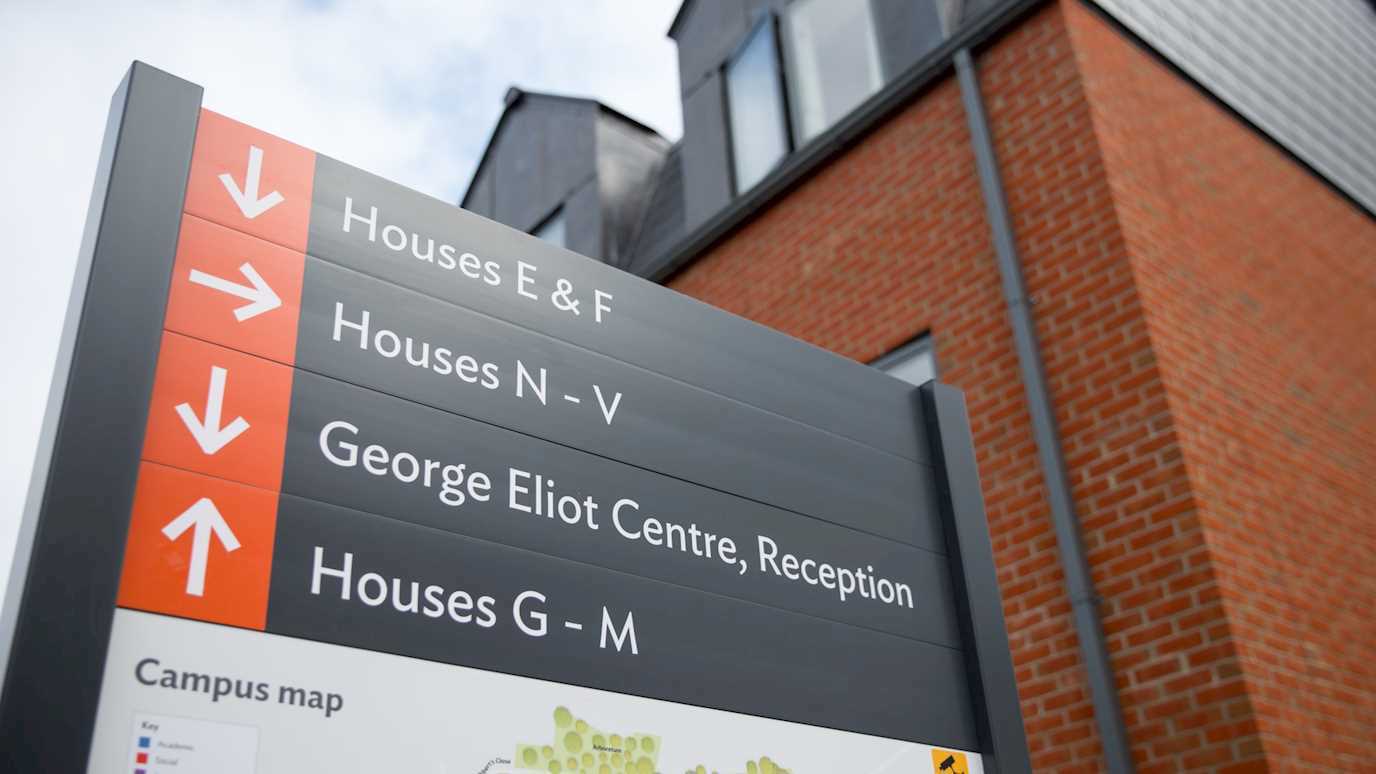
Royal Holloway and Bedford New College has recently reacquired one of the original signs of Hanover Lodge*, one of Bedford College’s halls of residence (pictured below).

Built in 1827, Hanover Lodge was designed by the architect John Nash, and stands in the Outer Circle of Regent’s Park. It was leased in 1947 as a residence for around 30 Bedford College students and it was extended in the 1960s to accommodate larger student numbers.
In the last edition of the Bedford Society newsletter, we asked for memories and photos of Hanover Lodge to mark the return of the sign to the College. Those submitted are shared below.
*returned with thanks to Gary from Surrey Antiques.
Joan Dungworth (née Crossley)
English 1963
In October 1960 I moved into Hanover Lodge - one of the last students to live in the original villa before the new hall of residence was built. The villa housed 30 students and our warden was Mrs. Stayt, whose father had been Astronomer Royal. Miss Agnes Mary Christabel Latham, the Reader in the English Department had a large room on the ground floor. We had a splendid cook, Miss Joyce Tippet, a cousin of Michael Tippet, the composer. Her meals were delicious! I particularly remember Christmas pudding with fresh cream and caster sugar, boiled mutton and caper sauce and cod steaks with sliced onion. My friend, Ginny and I shared a large room on the first floor. There were no showers but we had the use of a nearby bathroom with a huge bath with enormous brass taps. I believe that our room was heated by a cast iron radiator supplemented by a tiny coin operated electric fire. The room was lit only by a central 25 Watt bulb and it was not unusual for the lights to fail, if anyone used a hairdryer! In the grounds we had the use of a tennis court and a sunken formal garden. On Sundays we had to be in Hall by 10.30pm and my husband and I often recall with a smile how we had to leave the Albert Hall part way through a concert by Yehudi Menuhin and David Oistrakh, so that I should not be locked out. In our second year Ginny and I moved to the ground floor to bedrooms formed by partitioning a large reception room into 3 single rooms but we were not there for very long. When construction of the new Hall began we moved to the top floor of The Holme above the English Department under the care of Dr. Grace Dunlop (later Page). In our final year most of us moved back to the Hanover Lodge site. About 6 students lived in "The Flat" on one side of the Park Road entrance and the rest of us were on the opposite side of the road at 123, Park Road. Miss Tippet was now our Warden, so we continued to enjoy her cooking in our basement kitchen/dining room in Park Rd.
Mary Olivari (née Maclean)
History 1967
I lived in Hanover Lodge for my 2nd and 3rd years, 1966-7. I believe it was opened in 1965 so the building was brand new and felt palatial compared to the hostel where I had spent my first year. We had our own rooms with a modern desk and a wash basin. Each floor had a communal kitchen. But we were fed royally, eating large breakfasts before walking across the Park to college. In the afternoons the chef brought us delicious cake in the common room, which was the drawing room in the original building, previously the residence of the Russian Ambassador. We had views of the Regent's Canal on one side and the Park on the other. I couldn't have asked for a more delightful place to live in during my time at Bedford.
Jean McClenaghan (neé Taylor)
Geology research 1968, PhD 1972
I was one of the smaller number of postgraduate students who lived in Hanover Lodge between October 1966 and June 1968. This was a new experience for me as at my previous university I had lived in digs for two years and a shared student house in my third year. I appreciated being part of the Hanover Lodge community and the opportunity to develop friendships with other female postgraduate students, some of whom were from overseas; as I remember from Canada, USA and The Netherlands. I valued this female company, as in the Geology Department I was the only female postgraduate research student, only joined later by a female research assistant. One of my particular good friends was Judith Pearce who was researching the Married Woman’s Property Law. I’ve enclosed a photo of Judith and another friend Celia taken outside the Old House.


My accommodation was covered by helping out with the running of the Hall. I had a nice room in one of the new wings and was appointed to look after the well-being of the undergraduate students on my floor and make sure that everything was quiet and orderly. My single study room was well furnished with a bed, chest of drawers, wardrobe, bookcase, desk, lounge chair, small table and two chairs. Each floor had a large shared bathroom half way along the corridor and a small kitchen with basic utensils and an electric stove top for simple food preparation. I occasionally used this kitchen to entertain a very small group in my room.
As a postgraduate helper I had to spend time on the central desk in the entrance hall, checking students’ signing in and out in the book kept at the desk. This could be on weekday evenings but was often at weekends with a roster assigning our times. There was a curfew after which the main door was locked. As I remember, postgraduates could come in later by ringing a door bell to be admitted by a night porter. Sometimes, when spending several hours on the entrance desk, I would set up my sewing machine and use the time to do some dress making. The original Regency villa of Hanover Lodge contained common rooms and the apartments of the Principal Warden, Miss Beryl Stevens, and her deputy, Joyce. The Hall’s dining room adjoined the Old House and overlooked the Regent’s Canal. There was a long, raised platform at one end where the staff and postgraduates were seated, overlooking the student tables. One felt very much on show in this position. I did not eat in Hall every evening as I generally worked late in College and ate in the College Refectory. But I did eat breakfast in Hall every morning at the high table. I moved out of Hanover Lodge when I accepted a Research Assistantship at the Northern Polytechnic but continued visiting Bedford College frequently to see my research supervisor.

In 1971 I married a fellow geology postgraduate research student, Marcus McClenaghan, who had just been awarded his Ph.D. When I mentioned to Beryl Stevens that I was looking for a venue for our wedding reception she suggested that we could hold it at Hanover Lodge. So on Saturday, 21st August, 1971, after being married at St. John’s Church in Hampstead, Marcus and I with all our guests enjoyed a reception in the afternoon at Hanover Lodge. Our reception was in the Old House, principally in the wood-pannelled room which in term time was a common room containing a television, but flowing out into the elegant adjacent room with French doors. This room had a painting on the wall donated by parents in memory of a young student at Hanover Lodge who had sadly died.

Susan Bosanko
Chemistry 1970
First day: two of us from the same school sharing a taxi from Paddington, only to be told by the driver that Hanover Lodge was lived in by a princess and wasn’t for the likes of us. We did manage to talk him into taking us there, though. We only had suitcases with us, most of our belongings had been packed in our trunks which had been sent on ahead and were waiting for us when we arrived. My room was in the ground floor corridor, the section closest to the front hall. They had decided to put all of us with difficult medical histories together there, just in case of emergencies. I gather they never did this again, as we were apparently the noisiest group in the place. I remember a lot of sitting in each other’s rooms talking for hours, teaching each other to dance, practising eye makeup effects, all the usual things. It was usually tea or coffee, I don’t remember much alcohol except at parties and similar events in the common rooms. Several people had portable record players and/or radios, so there was plenty of music. The only television was in the common room – which was always crowded for Top of the Pops. All the rooms were singles, all the same size except for the rooms used by junior staff members. Each had a single bed, wash basin, wardrobe, and Ladderax units holding shelves, desk, etc. The problem with the Ladderax (bet they’d fetch a lot of money on the vintage market these days) was stability – they were fine unless someone put something heavy on the flap of the open desk, when they would tip over as they were not pinned to the wall. Loud crashes were frequent in the first few days. There were bathroom blocks in each corridor section, and also a kitchen with rings and grills, but no ovens or fridges. Rooms were cleaned for us, I think either once a week or once a fortnight. There were storage rooms for luggage. Each room also had a coin electric meter. Knowledge of how to jam these so that we got our power for free soon spread around – dishonest, but not something we considered at the time. Everyone had to be in by 10pm, or 11pm on Fridays and Saturdays, when the front door was locked. If you wanted to stay out later, you had to ask for a late key and give details of why, when you would be back, etc. These rules were gradually relaxed over the years, so by the time I graduated everyone could come and go as they pleased. However, while the rules were still in force it was very common for those of us on the ground floor to be woken in the night by people who’d stayed out past lockup. Although there were bars on all the ground floor windows, it was possible for the slim and flexible to slide through them. There were good reasons for the bars, as there were problems with flashers getting into the building. There was a fairly elderly man who got into the bathrooms in one section whenever he could, or else lurked outside. He was considered pretty harmless and was just shouted at and shooed out by students. The bars were also useful when a group of drunk male students (this was the early days of men joining the College) decided it would be fun to bang on my neighbour’s window in the middle of the night and try to get in. There were dangers to being in the poorly-lit Outer Circle when coming home in the dark. Not just the fairly harmless flashers, but also attacks. I was attacked myself, but must say that the police investigation was far worse than the attack. The students’ union did suggest laying on patrols as a form of protection, but that was considered a bad idea. There were times when women took to sharing rooms to give them a feeling of safety, and I was told of an incident when someone’s boyfriend rapped on their window one evening, only to find himself surrounded by a crowd of women rushing out armed with umbrellas and geology hammers There was a resident black and white cat called, I think, Whisky (after White & Mackays Black & White Whisky). He wandered in and out of rooms as he pleased, being fond of sitting in an open desk. He had to be moved when a duck and her ducklings settled on the small pond – he was sitting near the edge watching them for hours, and she wouldn’t stop her alarm calls the whole time he was there. Breakfast and an evening meal were included in the fees, and were available in the refectory. I think the food was the average institution fare of the time, I remember nothing specific about it good or bad. You weren’t supposed to remove food from the refectory, but people did – usually breakfast items to eat for lunch later. There were occasional dances in the common rooms. The most memorable was when ‘Wheels on Fire’ was a hit, and the band was booked for the dance. Julie Driscoll herself didn’t bother to turn up, but Brian Auger & the Trinity did. There were a lot of 21st birthday parties, that was still the coming-of-age date rather than 18. And ‘vicars and tarts’ was still a popular theme, it would not be approved of today. There was quite a large staff. Miss Stevens the warden was slightly terrifying but also extremely kind and pleasant, and I don’t think many people would argue with her. Her secretary, Helen Grant (now Langley) had been carefully chosen. Helen was a few years older than us, but close enough in age for us to feel free to talk to her. There were no counsellors or mental health services then, but she acted as a sounding board, supporting us over our low periods, and referring up to the warden if more help was needed. She worked at the desk in the entrance hall, so was easy to find. I remember her being particularly helpful to a Biafran student who had escaped the civil war in Nigeria. When Helen was off duty student volunteers staffed the desk, but didn’t have the same support function. One year I stayed at Hanover during the vacation (mainly to be with my then boyfriend) and saw a little of the filming of “The Rise & Rise of Michael Rimmer”, starring Peter Cook (of Peter Cook & Dudley Moore). It was a political satire, came out in 1970, never very popular, and seems to have disappeared without trace despite a starry cast. The white common room was supposed to be a room in 10 Downing Street. At some point during my time there they discovered dry rot in the original part of the building causing upheaval for the staff housed there, but not really for those of us in the new section. It turned out that Nash had been rather a jerry-builder: the beams that were supposed to be solid hardwood turned out to be pine casings filled with regency-era rubbish. I didn’t think I’d have much to say about Hanover, but it is amazing how just starting to write down a few memories triggers others, and then others.
Janet Pacey
Geography 1970
I arrived at Bedford College in the late afternoon on a Tuesday. I had been offered a place to study at Bedford College through clearing. When I set out that day from my home I had no idea where I would be spending the night. I met Les Turnbull in his office who informed me that there was a room for me at Hanover Lodge and was given a map to find it. The park gates were closed so I had to walk the long way round still carrying my suitcase. When I arrived at Hanover Lodge, I couldn’t believe how wonderful it was. I felt so lucky and so relieved. A single room on the ground floor fully equipped for study with a desk and shelves for books in a corridor with many other first year students. In each corridor there was a communal bathroom and a shared kitchen area to make snacks. The communal areas in the old building included a sitting room with a television and a dining room where breakfast and an evening meal were provided. The food was very good. On Sunday we had breakfast and lunch and were given bread, butter and jam for our tea to take back to our room. Bedding was provided and washed. It made my first year very safe and secure. The walk to college across the park was idyllic with the wildlife and the lake. It was so close to the college building and easy to get on public transport to travel other colleges or to the Senate House. I only wish I had returned there for my third year. It would have made more sense than being in a bedsit having to do all my own cooking and laundry and even pay to have a bath!
David Rudge
Geology 1973

Please find a couple of grainy photographs that I took. One is of Jenny Rudge (nee Shortall - History BA 1974) in her room at Hanover in July 1972. She is dressed for that year’s Summer Ball. You will remember the functional nature of the room’s furniture and notice how small that wardrobe looks! The second one is of Will Morgan (Physics BSC 1973). He is wearing my DJ which I wore at the Summer Ball of July 1971. This was taken in the quad with its wonderful peaceful atmosphere. Will was also the Hanover’s librarian which gave him the privilege of three year’s residence. In my first year’s stay my room overlooked this pond. I do remember that I seldom met the Warden, Beryl Stevens, but one meeting remains vivid. The “lads” and I were in my room with the window open and decided to play loudly the latest Curved Air LP (look them up). Soon Beryl appeared outside my window “Mr Rudge, whilst I find modern pop’s take on Vivaldi interesting, I doubt that those on the second floor have such openness. Please turn your music down”. I turned it off! It’s worth noting that Hanover had men on the ground floor and women on the two floors above. Visitors to either sexes had to sign in and out to ensure that nobody stayed overnight! Such a thought!! Mind you there were lots of visits from George Best, Ted Heath, Harold Wilson, etc., although I don’t think Arthur Scargill visited. Such ground floor windows had bars on them for obvious reasons.
So, back in Hanover for my third year. I had a room overlooking the Outer Circle with a view of a bush. Quite a change. It may have been a quiet room, ideal for serious studying, but it did not turn out that way. One late evening on a weekend there was knock on my window. Outside was a fellow student that I vaguely recognized pointing for me to open the window. “Let me in” he said. “I can’t”, I said, “there are bars.” “Second bar from the left” I tugged manfully to no avail. “No, my left” The bar swung sideways and in he popped disappearing into the corridor with a wave and a “Thank you”. This happened a few times, mainly weekends and at all times of the night. Some even came back to get out! Unfortunately, I was not studying as well as I could with such traffic so I had to get the bar fixed. So many men, so disappointed thereafter!
Hilary Clifton (née Wilson)
Geography 1977
Memories:
- as there were no fridges one bought half pint plastic bottles of milk from reception as anything larger would go off;
- the queues for the two telephone booths; amazing breakfasts consisting of every cereal you could think of and a full fry up. When we asked for something different we came down on a Monday morning to the smell of kippers, but they didn't appear till Thursday so I guess everything was reheated;
- if you were coming back late from a meeting or whatever, they would put a plate by for you and it was always rissoles, not the most appetising of food;
- the Royal Horse Artillery going past at about 7.30 in the morning on their training runs;
- the sounds of the animals in London Zoo drifting over on a still evening;
- the excitement of increased security when President Gerald Ford (I think) was on a state visit and staying with the American Ambassador, who lived nearby
- in my last year (76-77) being called to prayer on a Friday evening by a muezzin in the marquee next door which had appeared earlier, as they were building the Regent's Park Mosque
- asking Beryl Stevens (the warden) how she coped with the discos we had. Her reply was that she had all the after effects of being there without the positives of actually being there - little sleep, the smell of stale alcohol and smoke etc but all at second hand only!
Jeannette Clark (née Cockell)
German 1981
I was fortunate enough to be an inmate of Hanover Lodge (or Hanover Lodge, as we called it back in the 70s) in my first and final year. The Outer Circle, Regent’s Park was the poshest address I have ever had, and the location was idyllic. I loved the walk across the park to College and remember being on first name terms with the squirrels. Sometimes we were stopped by the Park Police for climbing over the fence when we didn’t quite make it back to halls from lectures before sundown, but fortunately no arrests were made.
The beautiful Regency buildings and the newly built central mosque housed our neighbours, although as I recall, we spent most of the time going out the ‘cat flap’ at the back of the Lodge to mingle with the locals at the nearby pub. In contrast to the grand exterior, living conditions in Hanover Lodge were a bit more basic by today’s standards.
Before the days of mobile phones, I remember a system of runners if anyone received a phone call and saving up all my coins to call home. I also fed piles of 5p coins into the meter for heating and electricity. Those were also the days of hard loo paper. My kids think it sounds Dickensian but at the time we felt we were living in luxury.
More than the location and facilities, it was the people who made Hanover Lodge. I enjoyed making friends with students from all different subjects, backgrounds and countries. In those days men were only allowed rooms on the ground floor and anyone who contravened fraternisation rules would be ‘spoken to’ by the kind but formidable warden, Beryl the Peril.
I remember lots of fancy dress parties, although sourcing costumes in the punk era was pretty easy with the abundance of bin, liners and safety pins.
It is with great fondness that I look back at my time in Hanover Lodge and the wonderful people I got to know there.