Researchers have found our emotions towards politics not only plays on our minds, but shapes how our bodies respond to political experiences, even driving political participation higher.
The new study, published in the Proceedings of the National Academy of Sciences, reveals that political emotions are not simply experienced as everyday feelings directed at political topics, but are felt differently in the body, becoming a key driver of how we participate in democracy.
The research was led by Dr Andrea Vik and Professor Manos Tsakiris from the Department of Psychology, Royal Holloway, University of London, and the Centre for the Politics of Feelings at the School of Advanced Study, University of London, with collaborators from Spain and USA.
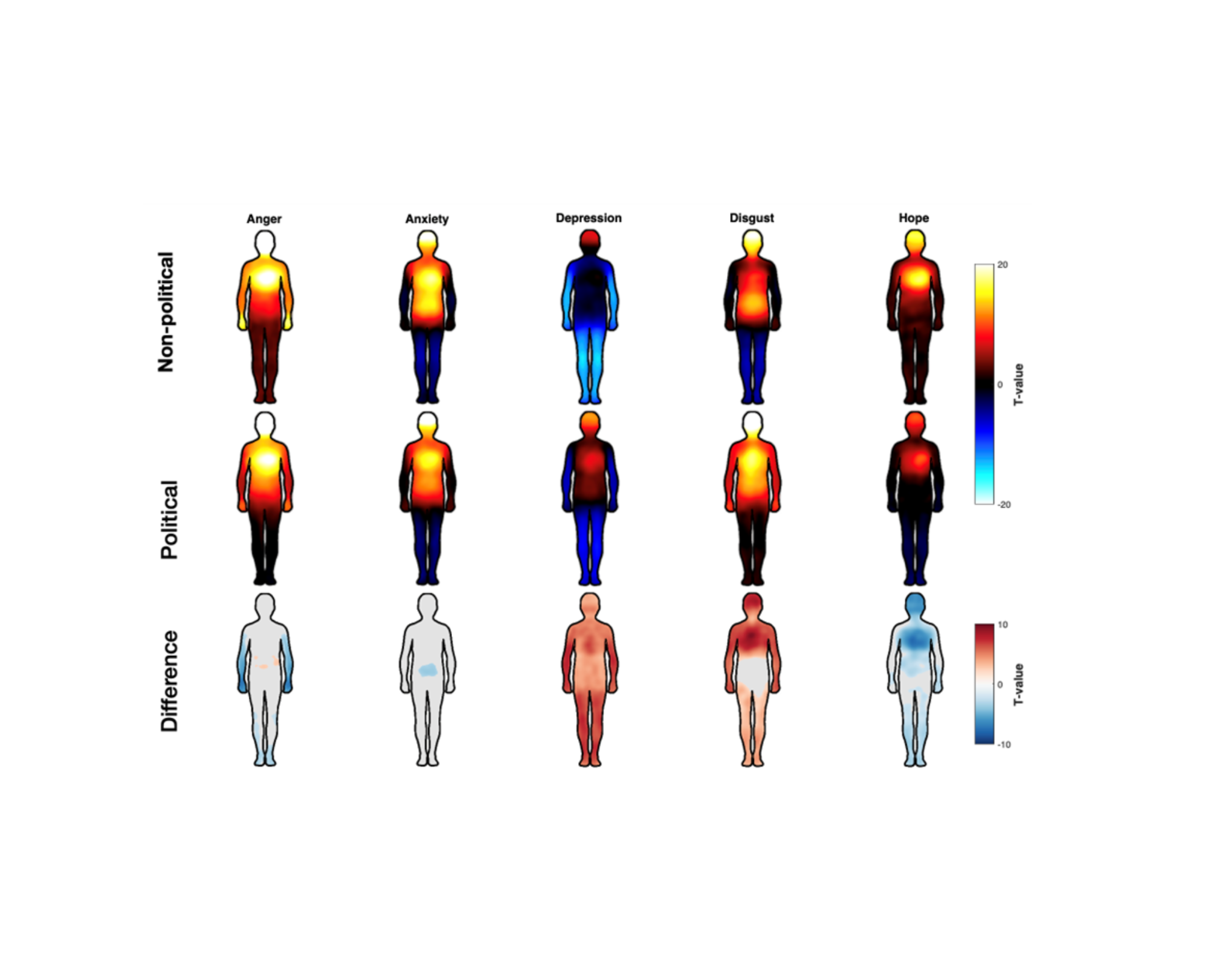
The study asked nearly 1,000 participants from the US to draw maps of body locations where they feel emotions, such as anger, anxiety, depression, disgust, and hope in everyday life.
They then had to do the same again while thinking about a political issue that evoked each emotion.
People’s responses were used to produce detailed ‘body sensation maps’ that allowed the researchers to see if and how the experience of political emotions is different from the way in which we experience emotions in our everyday life.
The results showed that giving emotions a political context significantly reshapes where and how those emotions are felt in the body.
Political depression, for instance, was characterised by more widespread and intense sensations in the body and lacked the typical numbness, as seen by a loss of bodily sensations in the limbs, of everyday depression.
This suggests that politically directed despair may mobilise, rather than shut people down.
The study indicates that political disgust doesn't feel the same in the body as ordinary disgust.
Where pathogen disgust, like reacting to vomit, is felt strongly in the stomach and throat, political disgust feels more like anger instead.
This suggests politics turns disgust into something more moral and outrage-based, and changes how we should think about disgust in politics.
The study also found striking differences linked to political ideology.
Democrat-leaning participants reported stronger sensations in their bodies than Republican-leaning participants for negative political emotions such as anger, anxiety, depression, and disgust, and they felt these sensations particularly in their upper torso and head.
The authors saw a similar ideological divide when looking at left and right political orientation.
The study suggests this points to the existence of ideological bodies, the idea that political worldviews may be lived and reproduced, not just in how we think, but in how we physically experience the world.
Perhaps most striking for democracy is the finding on political participation.
The strength of a person’s embodied political emotions, how broadly and intensely those emotions were felt in the body, was a reliable predictor of political participation, including voting, protesting, signing petitions, and online advocacy.
It is specifically the bodily experience of political emotion that mobilises people into democratic action.
Lead author, Dr Andrea Vik, from Royal Holloway, said: “We tend to think of political emotions as things people simply think about, like how angry are you on a scale of one to ten.
“But emotions are so much more than a scale; emotions are felt and lived through the body. We may feel ‘butterflies in our stomach’ or ‘weak in the knees’.
“We find that politics changes these bodily experiences of anger, anxiety, disgust, depression, and hope. And it is the impact of that embodied experience, not the number someone gives on a survey scale, that may motivate people to participate in politics.
“Ultimately, our bodies play a part in our politics.”
Professor Manos Tsakiris, senior author from Royal Holloway, added: “This research asks a deceptively simple question: where and how do we feel politics in our bodies.
“The answer turns out to matter enormously. We show that political context reshapes the very bodily fabric of emotional experience, and that these embodied political emotions are what drive democratic engagement.
“If participation in democracy depends on how politics is felt in the body, then differences and inequalities in how our bodies respond to politics could shape who acts and whose voices are heard; a question with profound implications for democratic life.”
As political developments grow increasingly volatile and dominate our daily attention, the emotions they evoke, like fear, anger, disgust or hope, do not remain dormant.
They are embodied and acted upon in ways that can shape our behaviour and the future of democracy.